
Details of the new health insurance overhaul
WASHINGTON — The health care overhaul package is the most far-reaching health legislation since the creation of the Medicare and Medicaid programs. While the underlying Senate bill is now law since President Barack Obama signed it Tuesday, additional changes will occur if the Senate passes the House of Representatives' reconciliation-bill part of the package.
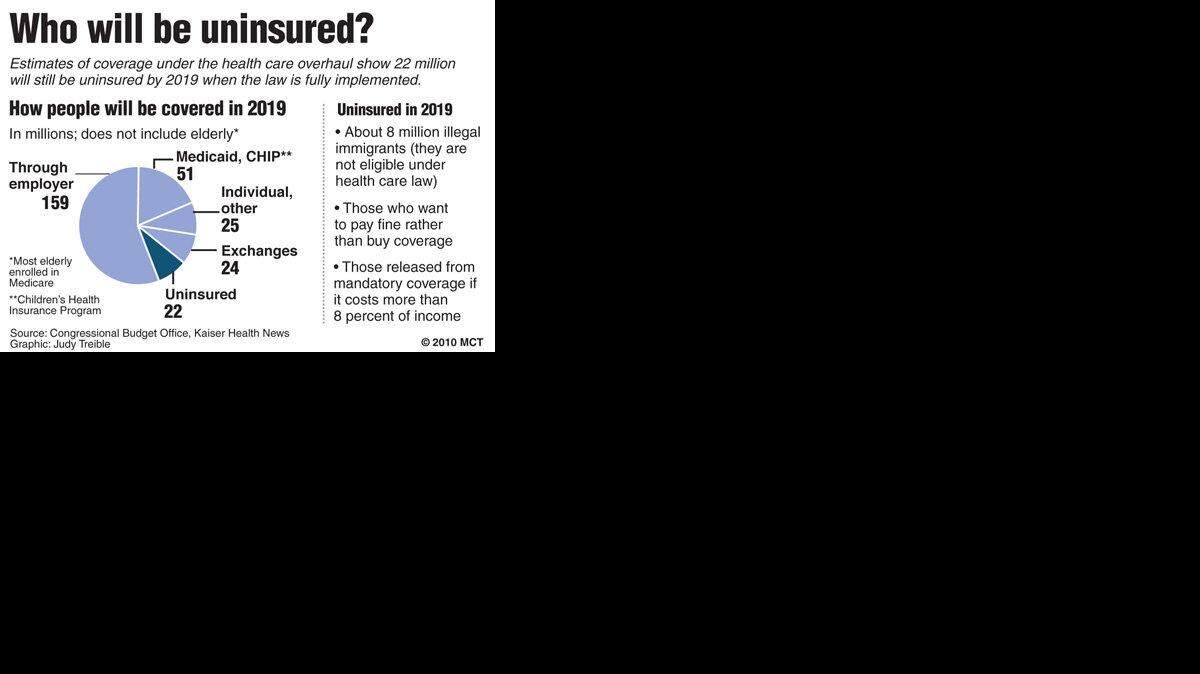
The following is a look at the impact of the entire package, which would extend insurance coverage to 32 million Americans but also would affect almost every citizen:
Q: I don't have health insurance. Would I have to get it, and what happens if I don't?
A: Under the legislation, most Americans would have to have insurance by
2014 or pay a penalty. The penalty would start at $95, or up to 1 percent of income, whichever is greater, and rise to $695, or 2.5 percent of income, by 2016. This is an individual limit; families have a limit of $2,085. Some people would be exempted from the insurance requirement, called an individual mandate, because of financial hardship or religious beliefs or if they're American Indians, for example.
Q: I want health insurance, but I can't afford it. What do I do?
A: Depending on your income, you might be eligible for Medicaid, the state-federal program for poor people and those with disabilities, which would be expanded sharply beginning in 2014. Low-income adults, including those without children, would be eligible as long as their incomes didn't exceed 133 percent of the federal poverty level, or $14,404 annually for an individual and $29,326 for a family of four, according to current poverty guidelines.
Q: What if I make too much for Medicaid but still can't afford coverage?
A: You might be eligible for government subsidies to help pay for private insurance that would be sold in the new state-based insurance marketplaces, called exchanges, slated to begin operating in 2014.
Premium subsidies would be available for individuals and families with incomes of 133 percent to 400 percent of the poverty level, or $14,404 to $43,320 for an individual and $29,326 to $88,200 for a family of four.
The subsidies would be on a sliding scale. For example, a family of four earning 150 percent of the poverty level, or $33,075 a year, would have to pay 4 percent of its income, or $1,323, on premiums. An individual who earns 150 percent of the poverty level, or $16,245, would pay about $650. A family with income of 400 percent of the poverty level would have to pay 9.5 percent, or $8,379. For an individual who makes 400 percent of the poverty level, the cost of coverage would be $4,115.
In addition, if your income were below 400 percent of the poverty level, your out-of-pocket health expenses would be limited.
Q: How would the legislation affect the kind of insurance I could buy? Would it make it easier for me to get coverage, even if I have health problems?
A: If you have a medical condition, the bill would make it easier for you to get coverage; insurers would be barred from rejecting applicants based on health status once the exchanges are operating in 2014.
In the meantime, the bill would create a temporary high-risk insurance pool for people with medical problems who've been rejected by insurers and have been uninsured at least six months. That would occur this year.
Starting later this year, insurers no longer could exclude coverage for specific medical problems for children who have pre-existing conditions.
They also no longer could set lifetime coverage limits for adults and children.
In 2014, annual limits on coverage would be banned.
New policies sold on the exchanges would be required to cover a range of benefits, including hospitalizations, doctor visits, prescription drugs, maternity care and certain preventive tests.
Q: How would the legislation affect young adults?
A: If you're an unmarried adult younger than 26, you could stay on your parent's insurance coverage as long as you aren't offered health coverage at work.
In addition, people in their 20s would be given the option of buying "catastrophic" plans that would have lower premiums. The coverage largely would kick in only after the individual had $6,000 in out-of-pocket expenses.
Q: I own a small business. Would I have to buy insurance for my workers?
What help could I get?
A: It depends on the size of your firm. Companies with fewer than 50 workers wouldn't face any penalties if they didn't offer insurance.
Companies could get tax credits to help buy insurance if they have 25 or fewer employees and a work force with an average wage of up to $50,000 a year.
Tax credits of up to 35 percent of the cost of premiums would be available this year and would reach 50 percent in 2014. The full credits are for the smallest firms with low-wage workers; the subsidies shrink as companies' work forces and average wages rise.
Firms with more than 50 employees that don't offer coverage would have to pay a fee of up to $2,000 per full-time employee if any of their workers got government-subsidized insurance coverage in the exchanges. The first 30 workers would be excluded from the assessment.
Q: I'm over 65. How would the legislation affect seniors?
A: The Medicare prescription-drug benefit would be improved substantially. This year, seniors who enter the Part D coverage gap, known as the "doughnut hole," each would get $250 to help pay for their medications.
Beyond that, drug-company discounts on brand-name drugs and federal subsidies and discounts for all drugs would reduce the gap gradually, eliminating it by 2020. That means that seniors, who now pay 100 percent of their drug costs while they're in the doughnut hole, would pay 25 percent.
Further, as under current law, once seniors spend a certain amount on medications, they'd get "catastrophic" coverage and pay only 5 percent of the cost of their medications.
Government payments to Medicare Advantage, the private-plan part of Medicare, would be cut sharply starting next year. If you're one of the 10 million enrollees, you could lose extra benefits that many of the plans offer, such as free eyeglasses, hearing aids and gym memberships. To cushion the blow to beneficiaries, the cuts to health plans in high-cost areas of the country such as New York City and South Florida — where seniors have enjoyed the richest benefits — would be phased in over as many as seven years.
Beginning this year, the bill would make all Medicare preventive services, such as screenings for colon, prostate and breast cancer, free to beneficiaries.
Q: How much is all this going to cost? Will it increase my taxes?
A: The bill is estimated to cost $938 billion over a decade. Because of higher taxes and fees and billions of dollars in Medicare payment cuts to providers, however, the bill would narrow the federal budget deficit by $143 billion over 10 years, according to the Congressional Budget Office.
If you have a high income, you face higher taxes. Starting in 2013, individuals would pay a higher Medicare payroll tax of 2.35 percent on earnings of more than $200,000 a year, up from the current 1.45 percent. The higher rate also affects couples earning more than $250,000.
In addition, people with those incomes face a 3.8 percent tax on unearned income such as dividends and interest.
Starting in 2018, the bill would impose a 40 percent excise tax on the portion of most employer-sponsored health coverage — excluding dental and vision — that exceeds $10,200 a year for individuals and $27,500 for families.
The bill would raise the threshold for deducting unreimbursed medical expenses from 7.5 percent of adjusted gross income to 10 percent.
The bill also would limit the amount of money you can put in a flexible spending account to pay medical expenses to $2,500 starting in 2013. Those who use indoor tanning salons will pay a 10 percent tax starting this year.
Q: What will happen to my premiums?
A: That's hard to predict and the subject of much debate. People who are sick might face lower premiums than they would otherwise, because insurers wouldn't be permitted to charge sick people more; healthier people might pay more. Older people still could be charged more than younger people are, but the gap couldn't be as large.
The bigger question is what happens to rising medical costs, which drive up premiums. Even proponents acknowledge that efforts in the legislation to control costs, such as a new board to oversee Medicare spending, wouldn't have much of an effect for several years.
In November, a CBO report on how the legislation, which at that point had a tougher "Cadillac" health-plan tax, would affect premiums said that big employers would see premiums stay flat or drop 3 percent compared with today's rates. It noted that premiums for employees with small-group coverage might stay the same. Americans who received subsidies would see their premiums decline by up to 11 percent, according to the CBO.
(Kaiser Health News is an editorially independent news service and is a program of the Kaiser Family Foundation, a nonpartisan health care policy research organization that's not affiliated with Kaiser Permanente.)
MORE FROM KAISER HEALTH NEWS
Coverage of the nation's health-care debate
MORE FROM MCCLATCHY
Kaiser Health News on McClatchy
Are there enough health care providers to handle newly insured?
Who should be at Obama's health care signing? Truman
When health care bill's provisions would take effect
Check out McClatchy's politics blog: Planet Washington
This story was originally published March 23, 2010 at 4:03 PM with the headline "Details of the new health insurance overhaul."