
Scott Walker’s budgets: Reality doesn’t always match rhetoric
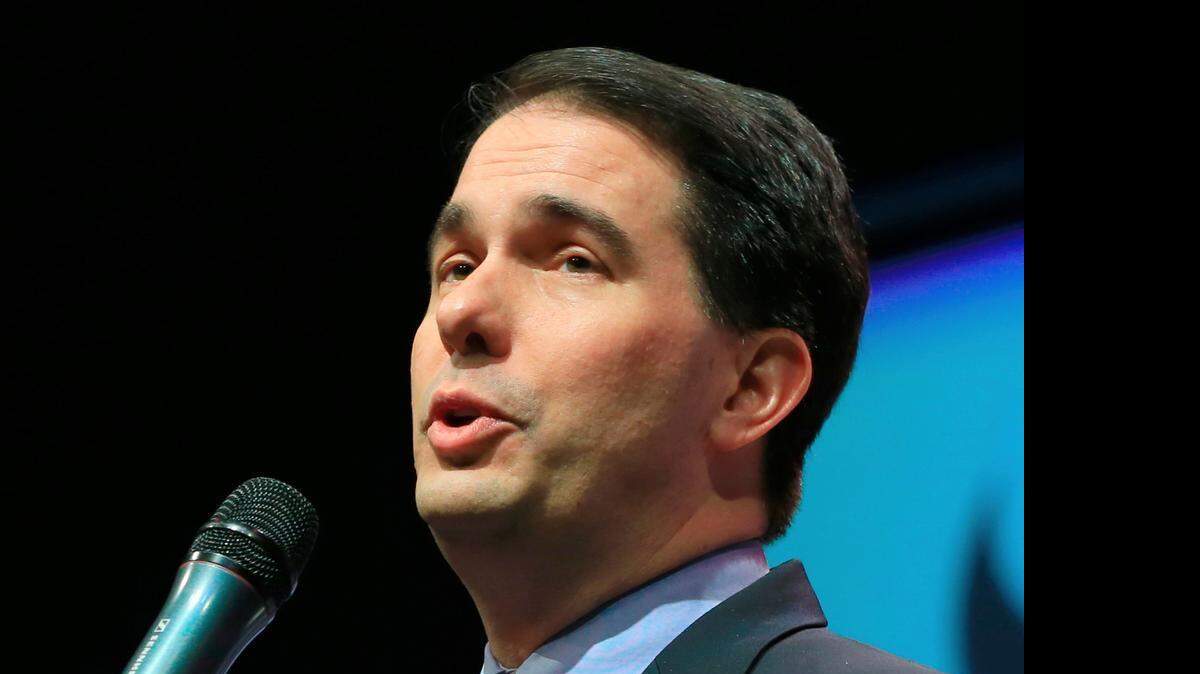
It is his top campaign boast as he runs for president, that he took a $3.6 billion deficit and turned it into a surplus.
It didn’t exactly happen that way.
Gov. Scott Walker of Wisconsin, a likely candidate for the Republican presidential nomination, routinely makes claims about his budget prowess that don’t always snugly fit reality. The way he describes the budget showdowns that made him famous isn’t always exactly right. And the general promise that things are working out great in Wisconsin still faces hurdles that could prove him wrong.
Spokeswoman Laurel Patrick says “there is no imbalance” in the Wisconsin state budgets, and Walker’s plans will produce surpluses in the years ahead.
But the numbers story hasn’t added up before.
Walker recalled in a recent interview how he confronted a $3.6 billion deficit when he took office in 2011 and wound up with a surplus. He mentions that feat frequently in his 2013 book, “Unintimidated,” and it’s a big applause line in early presidential primary states.
“We wiped out a $3.6 billion deficit without raising taxes,” he said in a 2012 campaign ad. He continues to make that claim; at a New Hampshire Republican meeting in April, he said, “We inherited a $3.6 billion deficit.”
The $3.6 billion deficit reflected the shortfall if state agency requests were met. But state agencies routinely ask for more than they’ll get, and their wish list didn’t add up to an actual budget deficit.
This year, such requests if fully met would produce a $2.2 billion deficit, a figure Walker routinely does not mention.
Walker urged McClatchy to look beyond all those numbers. “It’s not just what requests are. That’s what they asked for and we brought it down,” he said. And Walker can take credit for a $759 million state surplus at the end of fiscal 2013.
The Wisconsin Legislature’s Joint Committee on Finance has been in marathon sessions in recent weeks, writing a fiscal 2015-17 budget. The full legislature is expected to vote on a plan later this month. Walker knows he won’t get all he wants, but he was confident he can keep the budget lean. “We’ll make adjustments,” Walker said. “That (the budget) will end with a structural surplus.”
Walker also shades the meaning of another sort of budget deficit. One widely accepted method of gauging budget health is with the generally accepted accounting principles. It accounts for spending at the time it occurs, rather than when actual payments are made.
Using this method, Walker faced a shortfall of about $3 billion when he took office, and by the end of fiscal 2014, 11 months ago, saw it cut by more than half. Walker told McClatchy he’s taken significant steps to ease the state’s structural deficit. Structural deficits are less immune to the business cycle; they reflect underlying costs of government.
He’s correct. But calculated this way, Walker’s current budget would increase the deficit from $1.4 billion to a projected $2 billion. Stay tuned, Walker said. “In all those things obviously there’s more work we plan on doing,” he said.
Another Walker boast: He plans no new bond authorization for projects such as buildings or renovations in the upcoming budget. “In this budget, the total level of bonding is down to less than $1.6 billion,” he said in his 2015 budget address. “This is the lowest it has been in a decade.”
Critics say that masks two looming problems: He’s authorized no new bonding, so projects and maintenance costs are likely to be put off to future years. And Wisconsin is likely to borrow for transportation projects over the next two years.
Finally, to bolster his claim that he’s produced surpluses and will continue to do so, Walker cites a report from the nonpartisan Legislative Fiscal Bureau showing that overall, his budget plan would produce a surplus of $499 million at the end of the 2017-19 period.
While that’s an accurate reflection of the bureau’s analysis, the numbers assume Walker’s budget plan for 2015-17 will be adopted intact. It won’t.
This story was originally published June 5, 2015 at 2:49 PM with the headline "Scott Walker’s budgets: Reality doesn’t always match rhetoric."