
Donald Trump actually acted presidential — until he resumed being petulant
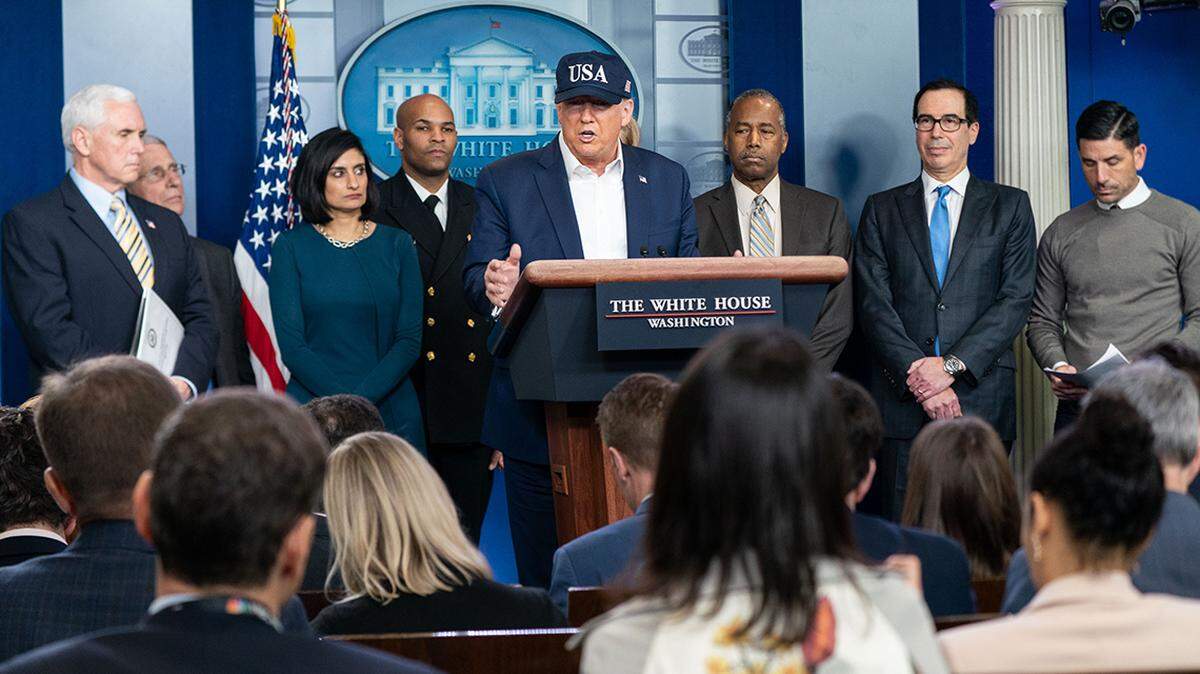
Ten days ago, on a Saturday, a casually-dressed President Donald Trump was in the White House doing whatever he does when his schedule says “No Public Events Scheduled.”
His new coronavirus task force, headed by Vice President Mike Pence, was about to hold one of its regular media briefings with federal experts outlining the government’s efforts to combat the invisible threat that seemed increasingly scary.
News briefings are priceless political tools when used strategically, to distribute important information the news media is eager to collect and pass on with that self-important tone so characteristic of the Washington press corps. Trump said he might attend the briefing and sit in the front row.
Of course, this president did not take a seat. Tieless, wearing his USA cap, Trump walked straight to the podium, where presidents belong at such times of perceived national crises.
He took charge and presided over the briefing with unusual authority, emphasizing the importance of the moment, then stepping aside (no, really) to let Pence and the experts offer details and insights.
Trump, as you may have noticed, is his own communications director. Whether touring a tornado-ravaged town or gabbing with Halloween trick-or-treaters, his instincts for the scene and his role are usually dead-on.
A little more than a year ago, Trump with good reason basically canceled the daily White House news briefings, which had become an institutional ritual, well, just because. They seemed like transparency of some kind.
But you can’t score points by always playing defense. Trump’s press secretary would appear and announce some minor schedule change or the like, guaranteed to be ignored, then endure a fusillade of questions.
Trump White House briefings became total shooting galleries with bored, hostile media desperately seeking news about conflict or hypocrisy, a perceived policy inconsistency or yet another rumored staff firing. Even a skilled press secretary was constantly forced into a prevent defense and that sometimes also became the news story. The boss was not happy, but it was his own fault for not being proactive.
On that recent Saturday, however, the boss was delighted with the positive public and media reactions. It was as if a light went on in Trump’s mind. If you’re talking to the public and media about something they’re eager to hear about, instead of just something you want to talk about, they’re attentive and appreciative, even pleased. Especially true in a time of unprecedented uncertainty when fear is so rife. One poll found Trump’s crisis net approval jumped 10 points in days.
The bluster returned some in ensuing days, but his more elegant, presidential behavior drew positive comments, even on CNN. Alas, though, it was not to last.
Last Friday, the chronic counterpuncher resumed his role as combative commander in chief, even when reporters uncharacteristically served up the kind of softball queries so familiar from the Obama days. The president called on Peter Alexander, a reporter from NBC, the network that branded Trump as a national celebrity with 14 years as a prime-time reality TV host.
This is a free country. In such settings, journalists should be allowed to ask any question at all, knowing they will in turn be judged on its quality or hostile stupidity.
Alexander began by asking about Trump’s effusive recent praise for an unproven drug, then delivered an open-ended query most politicians can only dream of: “What do you say to Americans who are scared?” That’s a perfectly legitimate question and an invitation to say anything he wants.
“I know Americans are scared. None of us have ever been through a pandemic like this as a nation. But we are a sturdy, resilient people. Americans can know that my administration and the respected experts here plus thousands of others across the country are working night and day to design an answer for this new virus, and as quickly as possible, a vaccine to prevent its return.”
Trump could have said something like that. He didn’t. Instead of a perfect opportunity to hail the earnest efforts of himself, Pence and experts, Trump lit into the reporter, calling it “a nasty question.”
“I say you are a terrible reporter,” Trump replied. “That’s what I say.” He added, “You’re doing sensationalism. And the same with NBC and Comcast. I don’t call it Comcast. I call it ‘Con-Cast.’”
Media bashing is a go-to part of Trump’s rhetorical repertoire. His solid base likely loves it, as they’ve liked the economy, millions of new jobs, tax cuts and soaring stock markets under Trump. But the virus and its accompanying shutdowns place all of that at risk now.
Trump fans like his fighting spirit. But this time, he blew a perfect chance to boast, accurately, choosing to punch when there was nothing to counter.
Then, at last Sunday’s briefing, the subject of Sen. Mitt Romney in virus isolation came up. “Geeee,” said the fellow Republican with gratuitous sarcasm, “that’s too bad.” Trump can’t seem to help himself.
Recently, his average job approval has hovered in the mid-forties. If every single one of those people was a registered voter, and if every one of them showed up to vote on Nov. 3, and if they collectively lived in just the right electorally important states, the president would get almost exactly the same 46% he did in 2016. Which was two points less than his unpopular, inept Democratic opponent.
Modern history shows Americans want to reelect an incumbent president. To become one, Trump could use a bit more cushion this time. And he could easily build that cushion by shedding the persistent presidential petulance and consistently behaving as he did for a few days last week.
The question is: Can he? His political future and much of his party’s depend on that.
This story was originally published March 24, 2020 at 6:00 AM with the headline "Donald Trump actually acted presidential — until he resumed being petulant."