
Obama faces an Africa hostile to gay rights
As president, Barack Obama has endorsed same-sex marriage, repealed a military requirement that service members keep their sexual orientation secret and offered gay federal employees family leave.
But Obama’s trip to Africa this week challenges the depth of his support for gay rights by taking him to a part of the globe where homosexuality can – and does – lead to arrest, harassment, discrimination, even death.
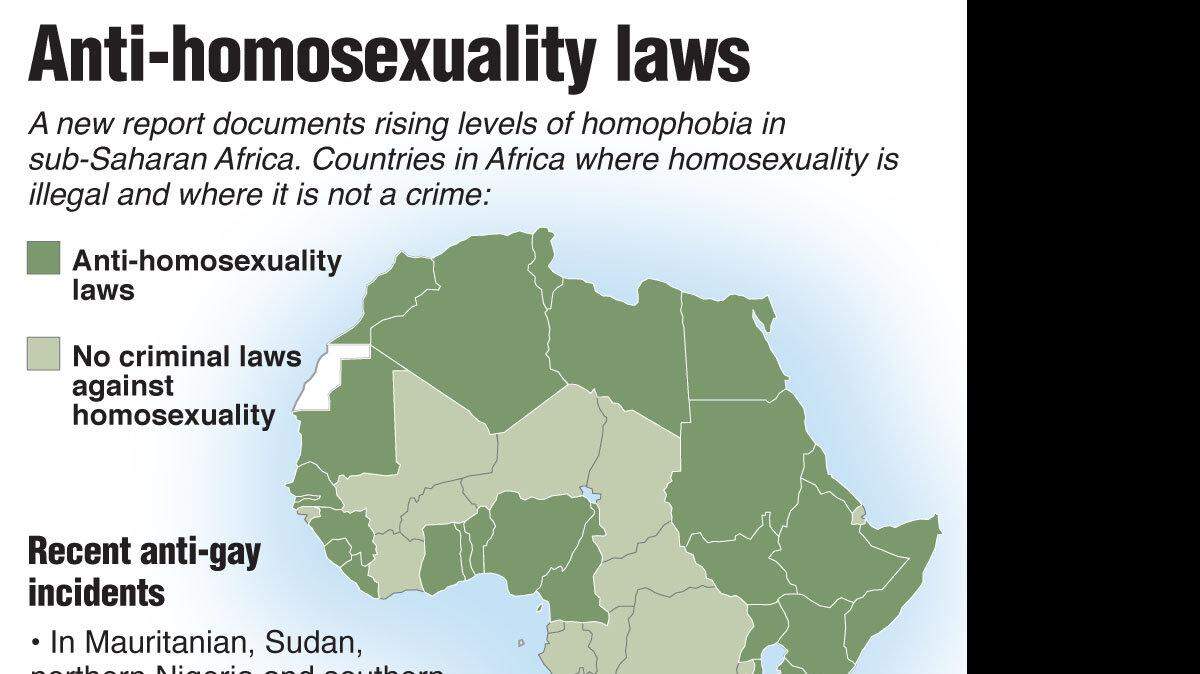
Obama is spending a week in a trio of nations in sub-Saharan Africa. In South Africa, where he arrived Friday night, violence against gays has escalated. In the other two on his itinerary, Senegal and Tanzania, homosexuality is a crime.
Human rights groups are urging Obama to speak publicly about the growing wave of homophobia in the continent, pressing nations to ensure the safety and rights of lesbian, gay, bisexual and transgendered people.
“His silence would be seen as indifference to their suffering,” said Adotei Akwei, an Africa expert and Amnesty International USA’s managing director for government relations.
In Senegal, the first stop of his trip, Obama did not challenge President Macky Sall on the issue in their closed-door meeting, but he acknowledged it later when asked about it by a reporter. Obama said that he believes that each country’s customs must be respected but that everyone should be treated equally.
“When it comes to how the state treats people, how the law treats people, I believe that everybody has to be treated equally. I don’t believe in discrimination of any sort,” Obama said at a news conference with Sall. “And I speak as somebody who obviously comes from a country in which there were times when people were not treated equally under the law, and we had to fight long and hard through a civil rights struggle to make sure that happens.”
Responding to Obama, Sall described Senegal as a tolerant country that does not discriminate against gays but is not ready to decriminalize homosexuality, either.
“We are still not ready to change the law,” Sall said, speaking in his native French. “But of course this does not mean that we are all homophobic. But the society has to absolve these issues. It has to take time to digest them, bringing pressure to bear upon them, on such issues.”
The issue of homosexuality drew more attention this week after the U.S. Supreme Court made history with victories for marriage equality on a pair of highly anticipated cases – a challenge to California’s law that defines marriage as the union of a man and a woman and the Clinton-era Defense of Marriage Act, which bars the federal government from recognizing same-sex marriage even for couples married under state law.
Obama previously has called on nations to end discrimination against gays. In 2011, he directed the State Department to ensure that “U.S. diplomacy and foreign assistance promote and protect the human rights” of gays. Hillary Clinton, then the secretary of state, followed up in a speech marking international human rights day in Geneva, saying “gay rights are human rights, and human rights are gay rights.”
But few expected Obama to push the issue on this trip – the first significant visit to sub-Saharan African since he was elected. Instead, he is focused on trade, energy and democracy building. Some suggested he could quietly challenge laws through administrative practices, such as denying aid to nations that do not ease restrictions.
Jennifer Cooke, director at the Africa program at the Center for Strategic & International Studies, said Africa’s “deep conservative strand” puts Obama in a precarious position. “It would be a tricky strategy to push,” she said. “I don’t think he wants to back away and I don’t think he wants to lecture or create a backlash.”
In many countries, Africa experts say, opposition to homosexuality stemmed from colonialism. But religion, culture and a push by American-based evangelicals have continued to fuel the sentiment.
Homosexuality is illegal in 38 of 54 African countries. In Mauritania, Sudan, northern Nigeria and southern Somalia, those found guilty face the death penalty.
In the last five years, Uganda, South Sudan, Burundi and Liberia have attempted to further criminalize homosexuality, while Nigeria’s president is considering signing a bill that would ban same-sex marriage and impose prison sentences for gays who show affection in public or advocate gay rights.
Africans are being harassed, discriminated against in health care, housing and employment and attacked because of real or perceived sexual orientation, according to a report released this week by Amnesty International. In some countries, people are arrested after being reported to police as being gay, sometimes leading to invasive medical exams as police search for evidence of same-sex conduct.
South Africa has broad protections for homosexuals, allowing marriage and adoption by same-sex couples. But it has also seen at least seven people murdered in the last year because of their sexual orientation or gender identity, according to the Amnesty report.
“President Obama should use his visit to South Africa as an opportunity to recognize the steps leaders have taken to begin to address hate crime and to offer U.S. assistance in strengthen South Africa’s response to these serious crimes,” according to a statement from Human Rights First. For example, the group says, he should offer resources to train police and equip prosecutors and work with the government to develop a system to treat victims and document hate crimes.
In the United States, support for gay rights has reached an all-time high.
Obama became the first sitting U.S. president to endorse same-sex marriage. Four states passed ballot measures last year legalizing same-sex marriage. All but a handful of Democratic senators now support gay marriage. The Boy Scouts of America dropped its longstanding ban on gay members (although its ban on openly gay adult scout leaders remains in effect). The first active player in a major American male team sport came out as gay.
Felipe Sousa-Rodriguez, national field director for GetEQUAL, a gay rights group that recently worked to battle new laws in Uganda, said the group supported Obama’s trip so he could see the situation in Africa firsthand.
But, he said, Obama needs to remember that his work at home is not complete. He should sign an executive order to bar discrimination based on sexual orientation by companies that have federal contracts and to push for protections for same-sex couples in an immigration bill moving through Congress.
“There is still more he can do,” he said.
This story was originally published June 28, 2013 at 3:41 PM with the headline "Obama faces an Africa hostile to gay rights."