
Congress plans to slash spending. Cooper says Medicaid is threatened. Here’s what we know.
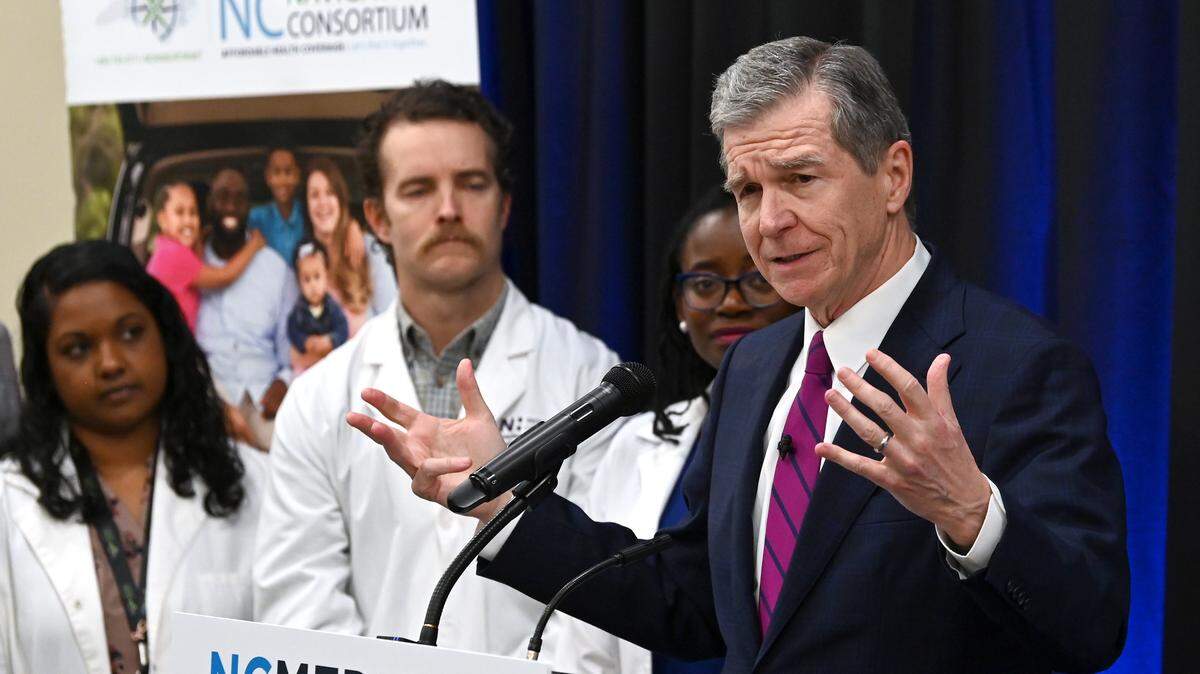
Former Gov. Roy Cooper posted on social media that the repeated promise President Donald Trump made not to cut Medicaid is now at risk after U.S. House Republicans approved a bill that “likely rips health insurance from 630k hard working North Carolinians.”
It’s one of several concerns about the bill that Democrats across the country have echoed since the vote last week. They say Medicaid, food benefits, higher education grants and more are at risk.
That includes North Carolina Democrats, who, led by Cooper in 2023, were able to reach an agreement with Republicans to pass Medicaid expansion — only to now, they say, have its federal funding jeopardized.
One of those Republicans, former House Speaker Tim Moore, is now in Congress. He told reporters at a news conference on Capitol Hill that there was a lot of fear-mongering over what would be cut.
“Look, nobody is going to hurt hard-working American people,” Moore said. “That’s not anywhere in here. Those are frankly just lies some people are telling.”
The Republican from Kings Mountain went a step further on Newsmax, saying there was “no way” there would be cuts to Medicaid, Medicare or Social Security.
Moore, a Kings Mountain Republican, said Majority Leader Steve Scalise “invited everybody in the media and everybody in the world to do a word search on that bill and see if those words even appear, and of course they don’t.”
So who’s right?
We’re months away from knowing, but the House Committee on Energy and Commerce is directed to find $880 billion in cuts, a massive undertaking that does not seem possible without cutting Medicaid. There are other options like cutting Medicare, or as The New York Times reported, everything else the committee oversees.
What happened?
On Feb. 25, the U.S. House passed a resolution — with North Carolina’s 10 Republicans in support and the state’s four Democrats opposed — that directs 11 House committees to submit, by March 27, a plan that includes $4.5 trillion in tax cuts and $2 trillion in spending cuts over the next decade.
The bill does not tell the committees how to make that happen.
And it still needs to go before the Senate for approval.
To complicate the matter, senators passed, a week prior, their own competing version of the bill, while members of the House were back in their districts. Senators worried that if they waited, House Republicans’ small majority might prevent its members from reaching an agreement.
That almost happened.
What’s next?
The two chambers now must decide which version of the legislation to move forward. And some Senate Republicans are already signaling that changes need to be made to the House version before they approve it.
Leadership from both chambers have made clear they oppose the other’s version.
Which means before anything can happen lawmakers in the House and Senate must come together to work out their differences.
Once they finalize a single bill that both groups can be satisfied with and pass, then the real work begins.
Committee meetings.
Votes.
More votes.
Negotiations.
A floor vote.
And likely more negotiations.
Eventually it could pass both chambers and make its way to the president’s desk.
But those final vote passages aren’t expected until the fall if Congress follows its standard budget timeline and process.
Social safety nets
In January, the House Budget Committee created a 50-page memo on where cuts could be made by each committee. The memo leaked.
And that set off alarm bells.
It included cuts to social safety net programs like Medicaid, the Supplemental Nutrition Assistance Program and Pell Grants. It also included how viable these options would be.
So when House Republicans passed their bill Tuesday night, Democrats expressed concerns.
“The House Republican Conference’s budget gives an unnecessary $4.5 trillion tax cut to the richest Americans and corporations while leaving poor and working class people behind,” said Rep. Alma Adams, a Democrat from Charlotte, in a news release. “To pay for it, they want to gut Medicaid, SNAP, and other essential programs that our families need to survive. I have no choice but to vote against this cruel and fiscally irresponsible proposed budget.”
McClatchy reached out to the North Carolina lawmakers who sit on the committees that would make these cuts to see if they could forecast where cuts might come from.
The team of Rep. Virginia Foxx, a Republican from Banner Elk, avoided answering the question, but directed McClatchy to listen to last week’s Rules Committee hearing instead. Early in the more than five-hour meeting, she stressed that the budget blueprint “does not contain any specific programmatic assumptions or cuts.”
Jaime Ioannidis, spokeswoman for Rep. Mark Harris, said Democrats’ claim that Republicans are trying to cut essential services “is simply not based in reality.”
“While we are still early on in the reconciliation process, one thing remains certain: Congress has a clear mandate from the American people to put our country back on a path to fiscal sanity, which starts with rooting out waste, fraud, and abuse in government programs,” Ioannidis said. “Representative Harris is committed to working with his colleagues to put our country on a fiscally sustainable path.”
SNAP benefits
Harris, a Republican from Charlotte, serves on the House Committee on Agriculture and the House Committee on Education and Workforce.
The Committee on Agriculture has been told to cut $230 billion from its budget.
The committee oversees the SNAP program, which provides low-income families with money to help with their grocery bills to buy healthy foods. Around 1.4 million North Carolinians and 9,300 businesses in the state benefit from the SNAP program.
But the memo released in January included several suggestions to the agriculture committee on where changes could be made to the program to save money.
Reps. David Rouzer, a Republican from Wilmington, and Don Davis, a Democrat from Snow Hill, also serve on the committee but did not respond to requests for comment.
Education
The House Committee on Education and Workforce is directed to cut $330 billion from its budget.
Adams and Foxx also serve with Harris on this committee.
Adams also did not respond to questions about potential cuts, but she addressed her concerns about Pell Grant funding in a news release the night the budget passed.
The 50-page document suggested capping Pell Grants at the median cost of attendance.
More than 203,000 students across North Carolina receive Pell Grants with an average of $4,996 per student, according to the Education Program Initiative.
Medicaid
Then there’s Medicaid.
The House Committee on Energy and Commerce has been directed to cut $880 billion from its budget. Medicaid is the committee’s largest program and is thought to be key in making that large of a cut.
The memo lays out how to do that.
One option is to cut matching funds for expansion states, like North Carolina.
State lawmakers included in the bill to expand Medicaid an automatic trigger to end Medicaid expansion if the federal government stopped supplying 90% of the program’s cost, The News & Observer previously reported.
Republicans continue to stress Medicaid will not be affected by the $880 billion cuts, but if it is it would affect 630,000 people in North Carolina.
“This is wrong and NC Republican leaders — in Raleigh and Washington — should hold the President to his word,” Cooper wrote.
Both Trump and House Speaker Mike Johnson reaffirmed that promise that Medicaid won’t be touched last week.
Rep. Richard Hudson, a Republican from Southern Pines, serves on the Energy and Commerce committee but did not reply to a request for comment about Democrats’ concerns over Medicaid or a forecast of where cuts might come from.
A government shutdown
Senators have punted decisions on the two budget blueprints to late March.
Instead, focus over the next two weeks will turn to a different budget and trying to prevent a possible government shutdown.
Congress has until March 14 to pass a budget or a continuing resolution for the current fiscal year.
Democrats want to use the budget as a bargaining chip to rein in the Department of Government Efficiency and Trump’s sweeping mandates, something Republicans won’t negotiate on.
Republicans want to pass a resolution to wait until September to take up the budget, but it’s not clear Democrats will go along with that.
If the two parties can’t come together, a government shutdown could happen.
This story was originally published March 5, 2025 at 9:00 AM with the headline "Congress plans to slash spending. Cooper says Medicaid is threatened. Here’s what we know.."
