
‘Republicans are emasculated’: Paul again clashes with McConnell on spending
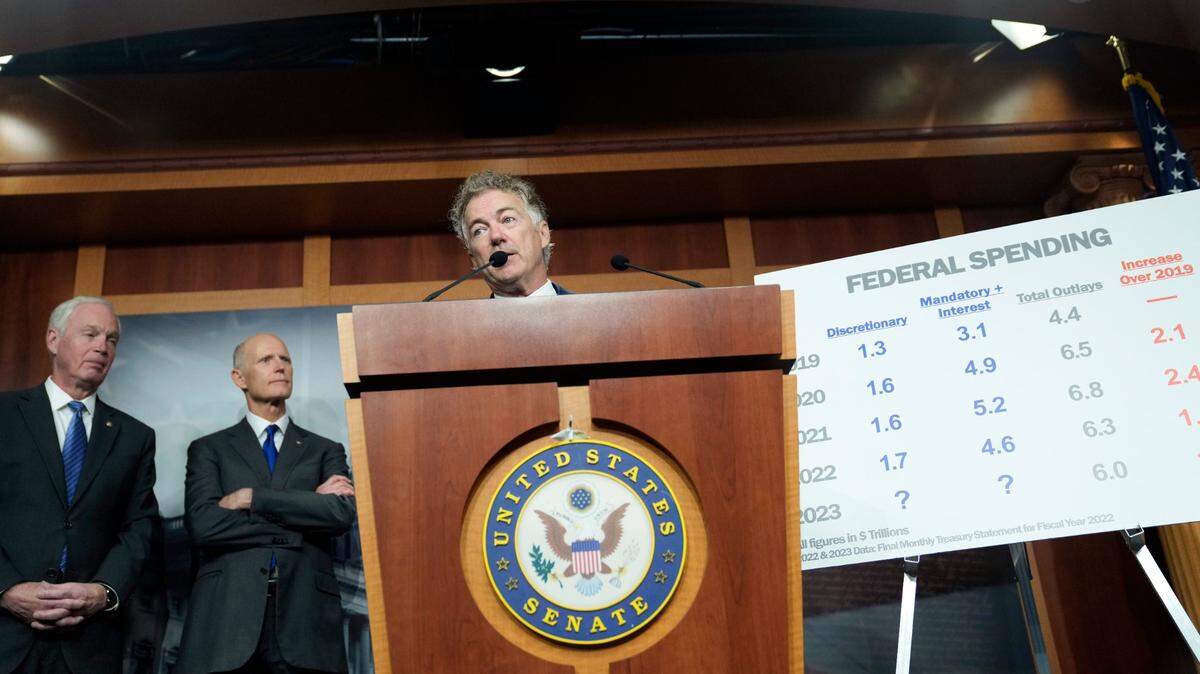
Rand Paul was just one of 19 to vote down a one-week Band-Aid budget agreement necessary to avert a year-end government shutdown.
Kentucky’s freshly re-elected junior senator was part of an even a smaller group of 11 who opposed must-pass legislation to fund the nation’s defense.
And he’s not done objecting this year.
With Congress forced to return next week to hammer out a long-term budget allocation for 2023 – known in Washington parlance as the “omnibus” – Paul is promising again to be a loud detractor, once again placing him at odds with his party’s leader and homestate colleague, Mitch McConnell.
“I think my job mainly is to oppose the omnibus,” said Paul, who is lambasting Republicans for failing to force Democrats to the negotiating table to bring down spending levels.
“This brings upon us the lie that Republicans really are fiscally conservative,” Paul told Larry Kudlow during an appearance on Fox News this week. “We have completely and totally abdicated the power of the purse. Republicans are emasculated, they have no power and they are unwilling to gain that power back.”
McConnell, who voted for both the short-term budget extension and the $858 billion National Defense Authorization Act, will be crucial in getting 10 Republican senators on board for next week’s omnibus vote.
But Paul is attempting to marshal 41 Republicans against it, which would prevent Democrats from securing the 60 votes the bill requires for passage.
“All it takes is 41 people to stand up, be men and women and say, no more, we’re not going to do it, we’ve had enough, we’re mad as hell, the deficit’s eating us alive, inflation’s eating us alive, and we’re not voting for an omnibus,” Paul said on Fox News.
Paul has allies on the right flank of his conference, but it’s unlikely he’ll be able to muster 41.
Wisconsin Sen. Ron Johnson complained that McConnell is trying to “coerce” Republicans to get on board with the $1.7 trillion all-encompassing package.
Sen. Mike Lee of Utah also questioned why Republican leadership would provide 10 GOP votes for the Democrats bill.
“They can’t do this without at least 10 Republicans in the Senate. I don’t know why any Republican, let alone 10 would want to help them,” he said, according to The Washington Times.
Paul ideally wants to force Democrats to break up the omnibus into 12 separate spending bills in different areas and withhold GOP votes for a few of them in order to attain spending concessions.
“We don’t like 87,000 new IRS agents to harass the middle class. We shouldn’t fund it but the only way we’ll defeat it is if we do the funding the way it’s supposed to be done: budget, 12 spending bills and then we put policy changes that our voters and our supporters want on the individual bills and then we debate each individual bill,” Paul said at a news conference earlier this month.
But that would take considerable time and lawmakers are up against another deadline of next Friday. What’s more is the bill also has to clear the House, where Republicans in the lower chamber are already blaming McConnell for the deal.
“Mitch McConnell is on the verge of taking away House Republican’s power of the purse next year by making a dirty deal with the Dems to pass a Dem Omnibus bill,” tweeted Rep. Marjorie Taylor Greene.
She wants McConnell to only agree to another short-term deal to allow the new House GOP majority in January to negotiate broader spending allocations.
“What the hell are Senate Republicans doing!” complained conservative radio host Mark Levin, a consistent McConnell critic. “McConnell talks about quality candidates. We need a quality GOP Senate leader and quality GOP senators. Not these fools.”
How far Paul will go next week to potentially block an omnibus. On Capitol Hill on Thursday, Paul indicated the risk that leadership would plan on “shifting all the blame” to conservatives if there’s a pre-Christmas government shutdown.
McConnell reiterated the hard deadline to pass an omnibus is next Thursday but if enough of his 50 member caucus defects, he said he would pivot to supporting another short-term agreement.
That scenario would amount to a win for Paul and fiscal conservatives, who would see another day to fight for their long-sought spending cuts in early 2023.