
Layoffs and delays threaten California’s high-speed rail as project faces funding hang up
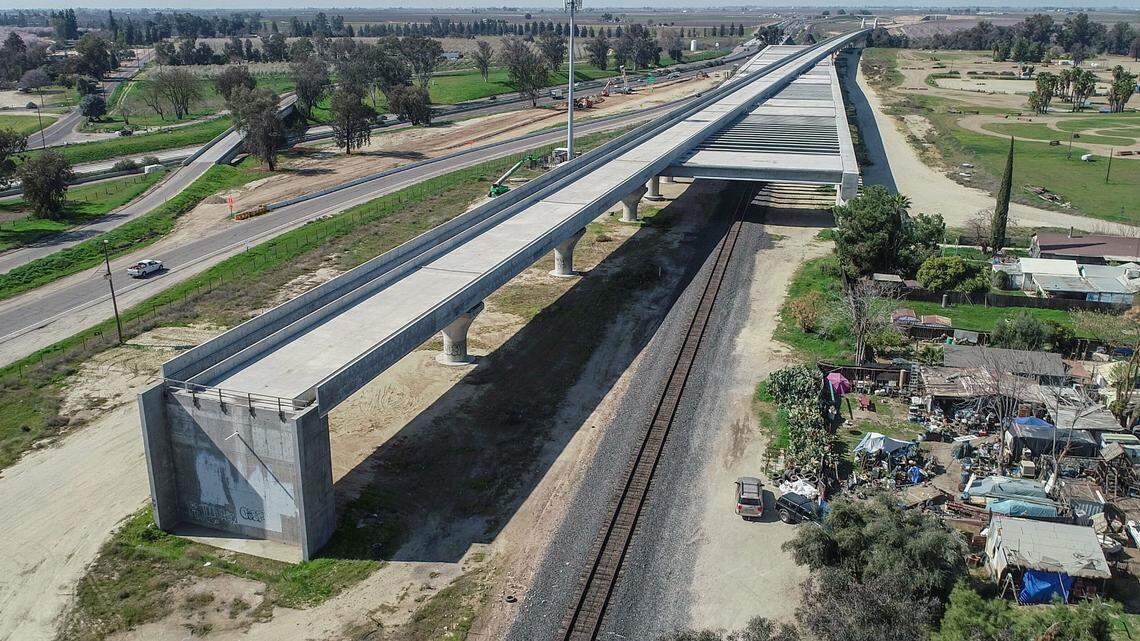
Top Democrats withheld billions of dollars in funding Gov. Gavin Newsom sought for the state’s high-speed rail line in the final days of this year’s legislative session, threatening construction delays and layoffs unless they come to a deal in early 2022.
Newsom earlier this year requested $4.2 billion to keep work moving in the San Joaquin Valley. He hit a wall in the Legislature, where Assembly Speaker Anthony Rendon and other Democrats have argued for directing the money to other urban transportation projects.
Holding back on the funding does not present an immediate problem for the project, according to a spokesman for the agency overseeing its construction. It could become more urgent by the middle of the next year.
“Without the allocation, high-speed rail construction will be impacted around mid-2022. By that time we would be forced to slow the pace of construction, resulting in layoffs and possible delay of new, long-term contracts necessary to complete the Central Valley segment,” said Micah Flores, spokesman for the California High-Speed Rail Authority.
At the end of last week, there were 866 daily workers on the authority’s 35 active construction sites in the Central Valley.
The money is what’s left of Proposition 1A, the $9.9 billion high-speed rail bond measure approved by California voters in 2008.
The Legislature crafted an end-of-session budget deal this week without approving the funding Newsom wanted.
He had sought the money this spring in his budget plan, to finish high-speed rail construction in the Central Valley, continue work to begin service between Merced and Bakersfield and provide planning and project design for the entire proposed 520-mile project connecting San Francisco and the Los Angeles Basin.
The high-speed rail project could receive funding from two other sources soon.
It’s expected to get some state money from cap-and-trade auctions like those in February, May and August, which resulted in $643.3 million for the authority.
Supporters also are eyeing the $1 trillion federal infrastructure bill, scheduled for a House vote Sept. 27. It could provide some funding since the Biden administration has been sympathetic to rail projects.
High-speed rail in trouble?
But California hIgh-speed rail supporters say they need the state bond money, and will try again in January to seek ways to release it. The Legislature’s 2021 session ends this week.
“We remain committed to continuing negotiations with the Legislature throughout the fall so we can come back early in the new year with a resolution that ensures California is well positioned to put new federal funding to use to build a better transportation future in this state,” said a statement from the governor’s office.
H. D. Palmer, state Finance Department spokesman, said the administration “Discussions surrounding the High Speed Rail Authority and other high priority transportation projects continue, and we expect there to be further action as part of early action in January. “
The line is envisioned as running between San Francisco and Los Angeles via Fresno and the San Joaquin Valley and eventually stretching to Sacramento and San Diego.
Bullet train cost estimates soar
The money’s release has been stymied by lawmakers tugging in two different directions.
On one side are Rendon, D-Lakewood, and Laura Friedman, D-Glendale, Assembly Transportation Committee chair, who want to trim spending on high-speed rail to free up money for other projects.
The rail project is well behind schedule and over the original budget. The estimate earlier this year was that the Merced-to-Bakersfield route was expected to cost as much as $22.8 billion, far above the original figure. The full project extending from the Bay Area to Los Angeles is projected to cost up to $100 billion.
The more sympathetic view of the project is that high speed rail will help take polluting vehicles off the road. Washington lawmakers have weighed in, pointing out that in order to get federal help the state needs to show it’s committed to the project.
The Biden administration has been an eager supporter, restoring in June $929 million that the Trump administration had rescinded two years earlier.
In July, Sens. Alex Padilla and Dianne Feinstein wrote to state legislative leaders urging them to approve the funding.
“Now is not the time for California to step back from its commitment to high speed rail, a mode of transportation that is critical to reducing congestion and meeting our critically important climate goals,” the California Democrats wrote.”
Tim Sheehan of The Fresno Bee contributed to this report.
This story was originally published September 9, 2021 at 8:00 AM with the headline "Layoffs and delays threaten California’s high-speed rail as project faces funding hang up."
.jpg)