
Does Supreme Court's Harvard-Yale dominance bother Obama?
WASHINGTON — There are about 1.2 million lawyers in the U.S. They learned their craft at 200 American Bar Association-approved law schools, of which the top 20 or so are the most competitive, all with top-notch professors and students.
When Justice John Paul Stevens retires this summer, however, the eight remaining members of the Supreme Court — the top arbiter of U.S. law and a check and balance on the White House and Congress — will be comprised entirely of legal minds trained at two law schools, Harvard and Yale.
(Justice Ruth Bader Ginsburg earned her law degree from Columbia, another Ivy League school — but only because she left Harvard Law after two years to follow her husband to New York for her final year of study.)
This Harvard-Yale predominance at the pinnacle of justice gives President Barack Obama yet another wrinkle to consider when seeking the best replacement for liberal anchor Stevens, in addition to experience, intellect, age, record, confirmability, gender, race, religion and geographic diversity.
Obama is a Harvard Law graduate, but he also promised to change how Washington works and to bring a greater diversity of Americans into the power structure.
Stevens attended Northwestern, in Chicago, now ranked 11th by U.S. News & World Report. The other seven justices, despite their diverse personal backgrounds, all earned their law degrees from Yale, now ranked No. 1, or from Harvard, No. 2.
Last year, for his first high-court nominee, Obama chose Sonia Sotomayor, a Yale Law grad with an up-by-the-bootstraps life story.
What will guide his decision this time?
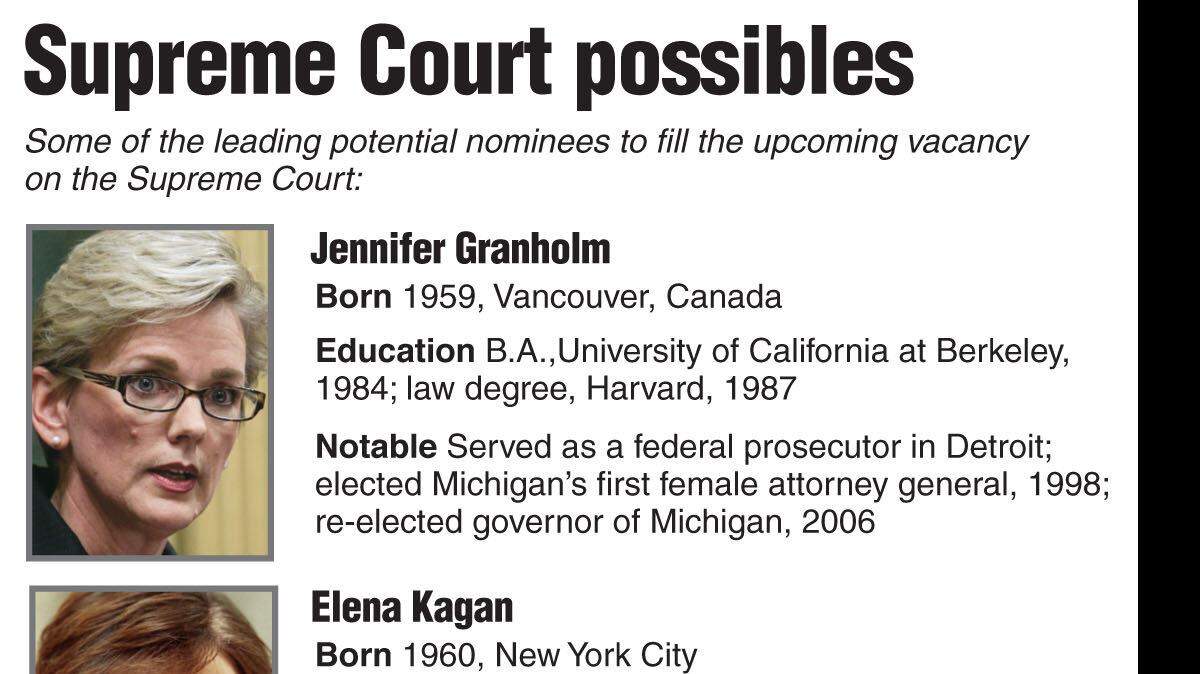
Insiders think that Solicitor General Elena Kagan, a Harvard Law alum and former dean there, is Obama's most likely pick. She's well respected, with top credentials. She survived the confirmation process to her current post. She's not been a judge, so she has no rulings to attack. Her stance supporting indefinite detention of terrorism suspects might help make her more palatable to Republican senators.
Most other names on Obama's list also studied law at Harvard or Yale, but not all.
Homeland Security Secretary Janet Napolitano, a former Arizona governor and attorney general, earned her J.D. from the University of Virginia (No. 10).
Diane Wood, a federal appeals judge for the Seventh Circuit, earned her law degree from the University of Texas at Austin (No. 15)
Leah Ward Sears, former chief justice of the Georgia Supreme Court, earned her law degree from Emory (No. 22) and a Master of Laws from the University of Virginia.
Sidney Thomas, a federal appeals judge for the Ninth Circuit, earned his J.D. from the University of Montana (No U.S. News ranking; Tier 3 school).
The White House declined to comment on this topic.
Sheldon Goldman, a political science professor at the University of Massachusetts at Amherst and an expert on the federal judiciary, doesn't consider the Yale-Harvard predominance on the high court a problem.
"One would expect the top legal minds of the country to have gone to the very best law schools," Goldman said. He called the concentration of justices from Harvard and Yale, as opposed to other top law schools, "somewhat of a coincidence."
"I can't buy that a Harvard or a Yale is so parochial that the people coming out have a narrow vision," he said. "If that were the case, we wouldn't have such a sharply polarized Supreme Court."
However, Jonathan Turley, a liberal law scholar at George Washington University (No. 20), disagrees.
Turley said the near-exclusive reliance on Harvard and Yale law grads is "perfectly absurd. . . . You're voiding a wide array of interesting and potentially brilliant nominees. It's like insisting you're only going to read books by two authors."
Turley calls the culture of the current court "remarkably inbred. You're taking justices from the same small educational pools, and those justices are reinforcing that same limited population pool in the selection of their clerks. There are certain dangers in small population pools. They tend to replicate the same types of thinking.
"More importantly, the United States has the deepest pool of lawyers and judges in the world. We have a remarkable number of extraordinary law schools."
Academic rankings of the top 20 law schools are "not only narrow but narrowing," Turley said. In addition, he said, U.S. history shows that some of the court's most important justices lacked academic pedigree, while many who had coveted Ivy credentials "were complete zeroes."
Ask Turley who he'd like to see Obama name to the court, however, and he'll tell you that he has two favorites: Wood, who studied law in Texas, and Harold Koh, a former Yale Law dean with a Harvard Law degree who's now advising the State Department.
Paul Mahoney, the dean of the law school at the University of Virginia (and a Yale Law grad), said the Supreme Court should be a meritocracy and that Obama should choose "someone who is intellectually up to the challenge. But that could as easily be someone from the University of Virginia or another law school."
Justice Scalia infamously told American University law students last year that one of his best clerks was Jeff Sutton, now a federal appellate judge, but that Scalia never would have chosen Sutton because he'd studied law at Ohio State (No. 34). Scalia inherited Sutton when another justice retired.
Alan Michaels, the dean of Ohio State's Moritz College of Law, earned a bachelor's from Harvard and a law degree from Columbia. He suggested that expanding the selection pools for clerks to the high court could make a difference over time in the institutional diversity of lawyers who later find a path to the Supreme Court.
However, Michaels said he doesn't think that institutional diversity should trump other considerations about the mix on the high court. He said gender, race, ethnicity and diversity of practice are key.
However, "being at Ohio State for 15 years, the best students we have are the equals of the top students I encountered at Harvard and Columbia," he said. "It's easy to use the institutions as a proxy," he said of the top-rated Ivy League schools. "It's safe."
Looking beyond those schools may require more effort, he said, but it's worthwhile.
ON THE WEB
U.S. News & World Report's ranking of law schools
MORE FROM MCCLATCHY
Follow the latest legal news at McClatchy's Suits & Sentences
With Stevens departure, a judicial era passes
Stevens' retirement sets up battle over Supreme Court choice
Last year's Supreme Court finalists, rise to top of Obama's list
Follow the latest politics news at McClatchy's Planet Washington
This story was originally published April 15, 2010 at 5:27 PM with the headline "Does Supreme Court's Harvard-Yale dominance bother Obama?."