
With Stevens' departure, a judicial era passes
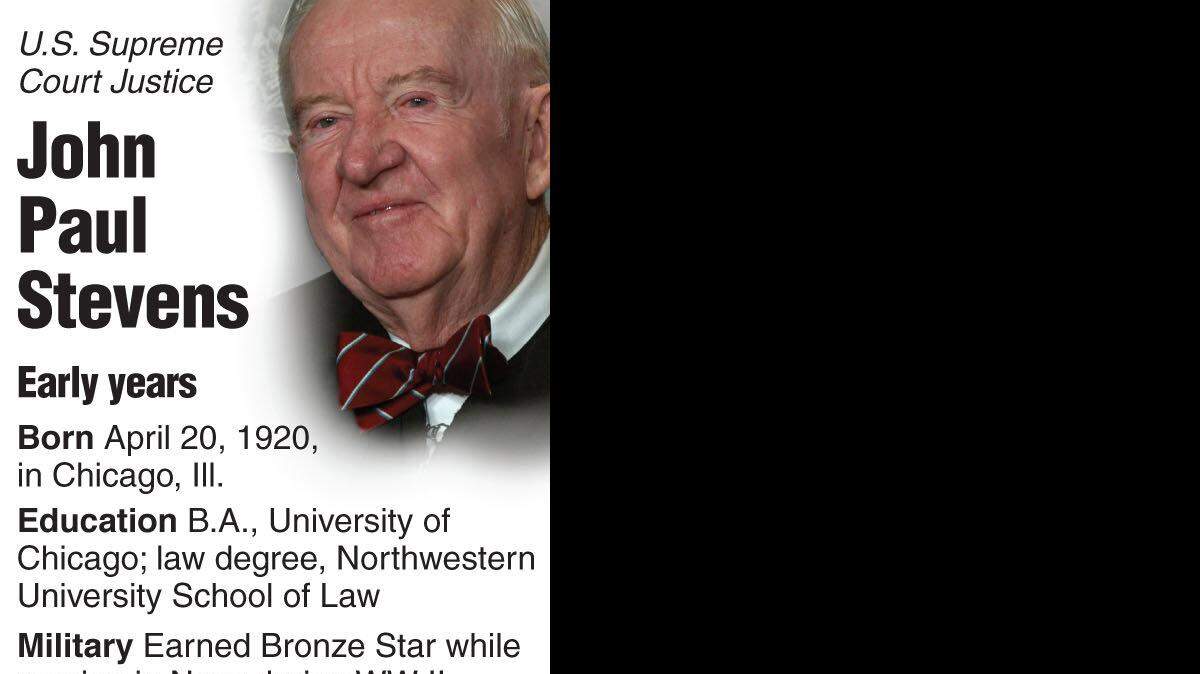
WASHINGTON — The impending retirement of Supreme Court Justice John Paul Stevens concludes several generations as well as a singular judicial career.
Stevens is the last World War II veteran who'll ever serve on the Supreme Court or, presumably, in high-level office anywhere. The unanimous Senate approval he won in 1975 may never be repeated in the hyper-partisan 21st century. His un-televised confirmation hearing was the last of its kind.
Not least, the moderate Republican reputation that Stevens brought to the court seems to have fallen from party favor.
"Stevens got labeled the leader of the court's liberal faction, but that label said more about the court than about him," said Joseph Thai, an Oklahoma University law professor and former Stevens clerk. "His middle-of-the-road pragmatism now aligns more with centrist Democrats … than with ideologically pure Republicans of today."
Stevens announced his retirement Friday shortly before his 90th birthday on April 20. When he steps down this summer, he'll still be several months younger than Oliver Wendell Holmes Jr. was when Holmes retired in 1932.
In historical stature, too, Stevens isn't quite accounted the equal of Holmes. Then again, few are. However, during a tenure that made him the fourth-longest-serving Supreme Court justice, Stevens shaped the law of the land in several ways.
"It's a legacy that's hard to pigeonhole, because he was not a justice with an agenda," Thai said. "Stevens practiced an old-fashioned form of judicial restraint, deciding cases narrowly on facts rather than broadly on abstract or absolute principles."
Stylistically, the former Navy intelligence officer has been a model of bow-tied decorum. Stevens is a persistent questioner during oral arguments, but he always starts politely.
"I'm just a little puzzled," Stevens told one attorney during an argument in March.
"May I just interrupt a bit?" Stevens asked another attorney the next day.
"Let me just ask," he began the day after that.
The graciousness seemingly summons a different time and place, a reminder that the Northwestern University Law School graduate once clerked for Justice Wiley Rutledge, a Franklin Delano Roosevelt appointee who was born in the 19th century.
Beneath the courtliness, however, is the kind of steel Stevens showed when he dissented from the court's 5-4 decision this year overturning corporate campaign spending limits in the case Citizens United v. Federal Election Commission."The court's ruling threatens to undermine the integrity of elected institutions across the nation," Stevens wrote. "The path it has taken to reach its outcome will, I fear, do damage to this institution."
Administratively, too, Stevens' seemingly old-school approach has set him apart.
He writes his own first drafts, sometimes working from his Florida home, rather than relying on his law clerks. His clerks individually review the nearly 10,000 petitions that come in annually, whereas other justices farm the work out to a common labor pool of clerks.
The eight other justices rule periodically that prisoners and others who repeatedly file frivolous lawsuits no longer may receive a special break on court fees. Stevens is routinely alone in voting to let the poor keep petitioning.
Substantively, he's made his mark in several ways.
Sometimes, his influence has been immense if largely unseen by the general public. In 1984, for instance, he authored a landmark, oft-cited decision involving Chevron that's directed courts ever since to defer frequently to government regulators.
More vividly, he's disagreed frequently with the government's position on criminal law, and he terms the death penalty the "pointless and needless extinction of life." During the George W. Bush administration, Stevens wrote two crucial decisions striking down military tribunals and upholding the right of Guantanamo Bay detainees to challenge their incarceration.
In 1994, when he became the senior associate justice, Stevens gained extra clout. When the chief justice is on the other side, Stevens assigns the job of writing an opinion. This can be crucial in holding a majority together.
In 2003, for instance, it was Justice Sandra Day O'Connor's name on the decision that upheld the University of Michigan Law School's affirmative action policies. Behind the scenes, though, it was Stevens who'd assigned O'Connor the delicate job.
An antitrust lawyer while in private practice, Stevens came to wider public attention in the late 1960s while he was leading an anti-corruption investigation in his native Illinois. He won appointment as an appellate judge in 1970, and then was promoted in 1975 by President Gerald Ford as having "the finest legal mind I know."
Often, he's been on the losing side.
During the Supreme Court's 2006-07 term, for instance, Stevens voted with the majority only 37 percent of the time. Though not always to this same degree, Stevens consistently has dissented more than his colleagues have in recent years, according to figures compiled by Scotusblog.com.
Neither the dissents nor the majority opinions necessarily seem written for the ages, and his opinions have steered clear of Justice Antonin Scalia's barbed sarcasm or Justice Anthony Kennedy's occasional reach-for-the-stars rhetoric. At times, though, Stevens' words have rung loudly, as when he lamented the majority's decision in the 2000 Bush v. Gore case, which secured the presidency for Bush.
"Although we may never know with complete certainty the identity of the winner of this year's presidential election," Stevens wrote in dissent, "the identity of the loser is perfectly clear. It is the nation's confidence in the judge as an impartial guardian of the rule of law."
MORE FROM MCCLATCHY
Follow the latest legal news at McClatchy's Suits & Sentences
The funeral of Chief Justice Rehnquist
Chief Justice William Rehnquist dies at 80
Review of Alito's opinions finds clear pattern
Roberts sworn in as chief justice of the U.S. Supreme Court
This story was originally published April 9, 2010 at 11:10 AM with the headline "With Stevens' departure, a judicial era passes."