
Rebel worry: How to control Islamists if Assad is pushed from northern Syria
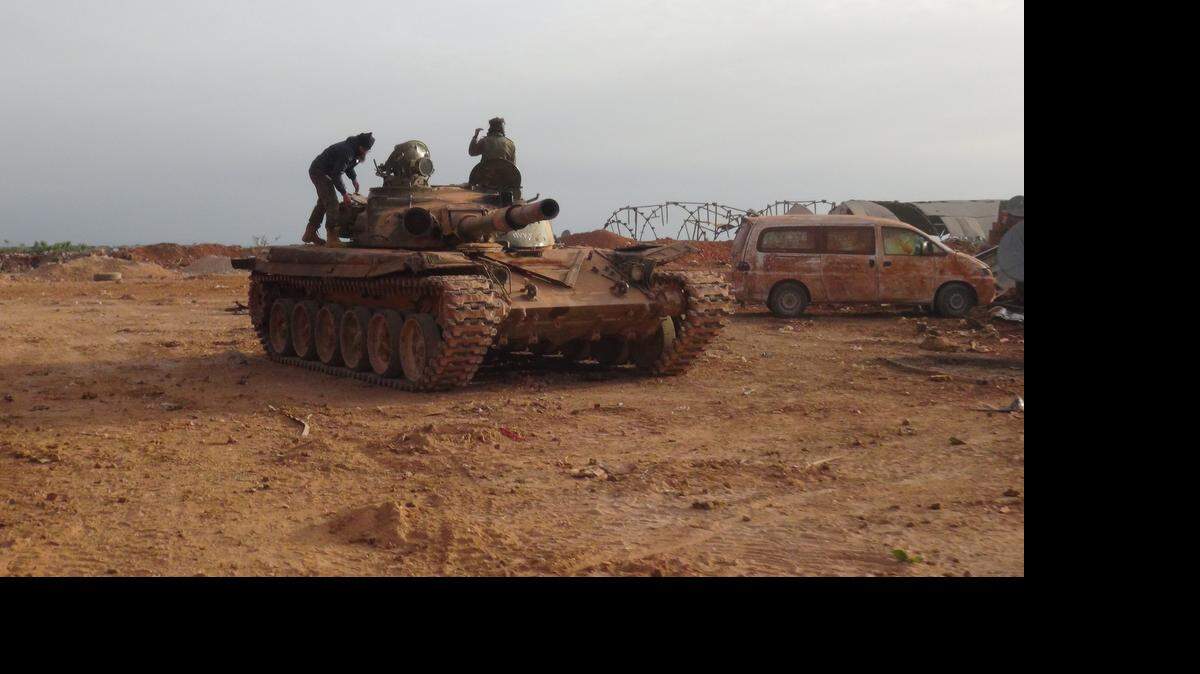
In three years of fighting, rebel commanders had never seen anything like the video that went up on the Internet last week. There was Brig. Gen. Suhail al Hassan, one of President Bashar al Assad’s favorite commanders, pleading with the Syrian defense minister for urgent help.
“Sir,” he began, speaking into his cell phone. “The fighters in al Ziara have retreated. There are 800 fighters. They are all around me and they want to go back. They only need ammunition. Please provide the ammunition,” he said. “Am I not right, men?”
The dozens of regime troops crowding around him shouted their agreement. “We are all ready to sacrifice our blood and our souls for you, Bashar,” they chanted.
The videos of Hassan begging for help – there are two versions of the scene that have been seen 82,000 times – are being viewed with delight and satisfaction among opponents of the Assad regime. “I know him. He was rattled. He’d lost his composure” said Col. Jemiel Radoon, a U.S.-backed moderate rebel commander.
With good reason. Government forces appear on the verge of being ousted from their last redoubt in northern Syria, and the forces under Radoon’s command had just blocked their escape route.
Three days after the video went up, the government was back on the attack, mounting, by rebel count, 150 air attacks, using barrel bombs, missiles and other munitions to clear the way for the retreat into the Ghab valley toward Latakia, the province where Assad’s Alawite followers predominate.
The back and forth in the Ghab Valley last week, with Radoon’s Sukur al Ghab forces pushing government forces out the northern part of the valley, then giving up three villages when confronted by the fierce aerial bombardment, is part of a much broader drama now under way: Disparate rebel forces, including Al Qaida’s Nusra Front, have stopped fighting each other and are coordinating operations against the government.
The force configuration seems to change with each battle. Al Qaida’s Nusra led the fighting at Idlib, the capital of the same-named province, which fell on March 28. Moderate rebels, some of whom have been supplied by the United States, were a major part of the anti-government force that captured Jisr al Shughour April 25. Two days later, Nusra was in charge of the Islamists that overwhelmed the Qarmeed military base.
Now Radoon’s moderate forces have set up positions in hopes of preventing the government troops, who’ve fled to the area around Ariha, from escaping west into the Ghab valley, their only imaginable escape route.
Radoon said regime troops are holed up at the Mastouma military base, east of Ariha, in the town itself, and on the hills surrounding it. He said the number could be as high as 5,000.
“It seems they’ve lost any interest in staying the area,” he said. “All they want to do is save their forces and their weapons. They are now fighting fiercely to secure the route for troops to retreat from Ariha.”
Radoon doesn’t want that to happen. To prevent government moves into the valley, his men blew up three bridges on the main east-west highway, he said.
Rebel advances of the past month have already changed the image of the once fractious resistance, as well as the Assad forces. Rebel commanders said it’s also changed the U.S. view of the Syrian conflict.
“The Americans didn’t support the battle of Idlib,” said Mohamad al Ghabi, who claims to command a moderate force of 3,600 that includes 100 officers and 2,000 military defectors. “But they supported the battle of Jisr al Shughour and the Ghab valley.”
That support came in the form of TOW anti-tank missiles and other military and logistical support. Ghabi, whose Sham Front is not among U.S. aid recipients, said other organizations that fought at Jisr al Shughour had U.S. supplies.
Radoon did not fight at Jisr al Shughour, but he said U.S. contacts supplied him with TOW missiles weeks ago when he explained his plans for countering government forces in the Ghab valley.
Ghabi said he’s hopeful that more rebel victories will quickly lead to a routing of government forces throughout northern Syria. If government troops are forced from Ariha, anti-Assad groups will control a vast territory from Hama to the Turkish border, and linking three provinces – Idlib, Hama and Latakia.
Key to the victories, he said, is a willingness of moderates, Islamists and al Qaida’s Nusra to work together.
“After four years of disunity, we came to the conclusion that if we are not united, we will not be able to defeat the regime,” said Ghabi. “So even if we don’t agree in our thoughts or our ideology, we must agree on the military task. We all share the same goal: toppling the Assad regime.”
To minimize frictions, each of the major groupings maintains its own operations room in a battle area, and they send out liaisons for joint meetings to iron out strategy, tactics and most important, which force takes which front. The main groupings are Jaish el Fateh, which groups the Islamist forces, Sham, which groups the moderates, and Nusra, which operates largely on it own.
What’s eased the collaboration is that the leadership of all the groups involved in many of the battles is local, he said.
But both Raddoon and Ghabi acknowledge concerns about what will follow if Ariha falls. Radoon says he’s managed to keep the Islamists and Nusra out of the Ghab valley offensive, but whether he can do that after Ariha falls is unclear. They worry the Islamists and Nusra will attack Christians and Alawites who’ve backed Assad.
“We are expecting trouble after Ariha,” he said. “Where will the Fateh group go after Ariha falls? They will go to our areas, mixed areas.”
Already, said Radoon, the Islamists and Nusra have far more weaponry, and the booty from Ariha will strengthen them further.
“We cannot speculate on what they will do,” he said.
One hope, Ghabi said, is more help from the United States. “If you give me support for 10,000 fighters, I will change the dialectic of the whole area,” he said. “We have professional officers. If we have support, we can rebuild the Free Syrian Army. In this case, people will come to the conclusion that there is an alternative to the regime of Bashar al Assad.”
This story was originally published May 3, 2015 at 1:24 PM with the headline "Rebel worry: How to control Islamists if Assad is pushed from northern Syria."