
In remote Baluchistan, Pakistan fights a shadowy war
QUETTA, Pakistan — The family of Jalil Reki learned from television news that his body had been found, more than two years after the political activist was allegedly abducted by Pakistani security officials.
Reki's body bore signs of severe torture, according to his father, Qadeer Baloch, including broken wrists and knees and burn marks. He was killed by several shots through the back of the head.
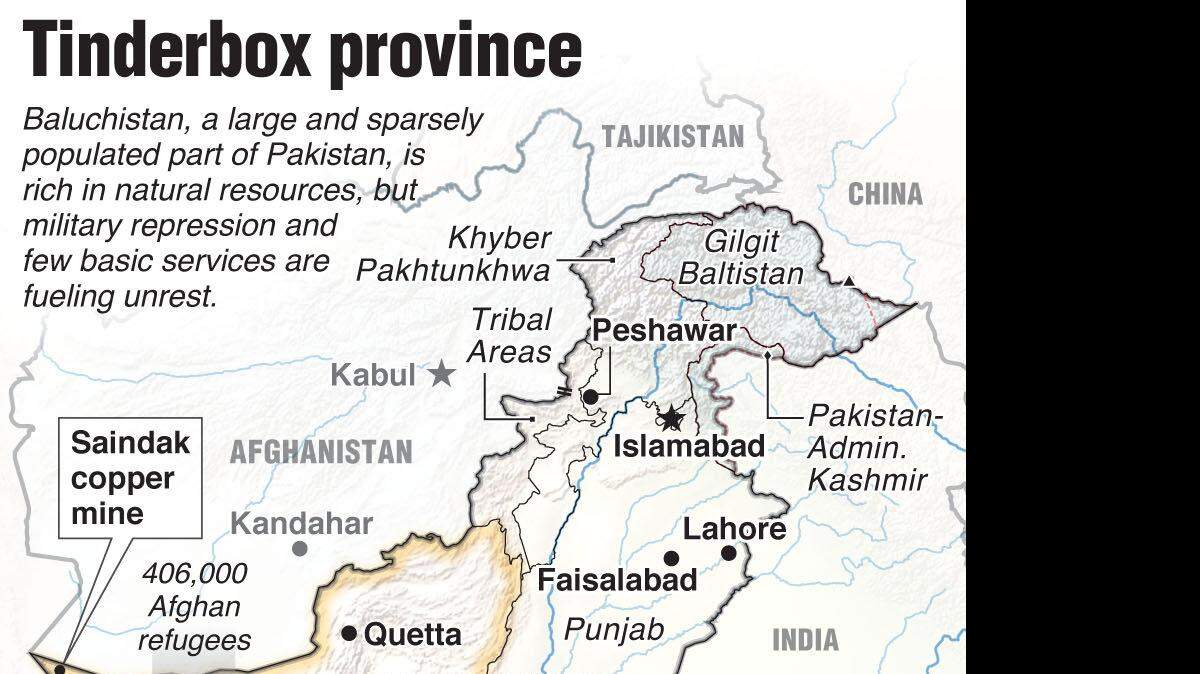
His grisly story is replicated across the remote and thinly populated western province of Baluchistan, where Pakistani forces are fighting a separatist insurgency that the outside world barely knows about. While the U.S. and other Western powers focus on the country's other war — against Islamic extremists in the northwest tribal areas bordering Afghanistan — the conflict in Baluchistan is raging mostly in the shadows even as violence escalates.
In a congressional hearing in Washington in February, Ali Dayan Hasan, Pakistan director for Human Rights Watch, said that since January 2011, at least 300 people had been abducted or killed in Baluchistan and their bodies abandoned. The acts are widely referred to as "kill and dump" operations, in which Pakistani security forces engaged in counterinsurgency may be responsible, Hasan said.
The increasingly bloody conflict also has another side: Baluch separatists have targeted and killed hundreds of settlers, mostly ethnic Punjabis who've lived in the province for generations, as well as fellow Baluch whom they accuse of siding with the Pakistani authorities.
Though largely ignored, the conflict has geopolitical ramifications. Neighboring Iran, too, has a restive Baluch minority population and is loath to see the insurgency expand. The provincial capital of Quetta is home to the leadership of the Afghan Taliban, which has coexisted peacefully with Baluch insurgents since Afghan refugees began arriving in the area decades ago.
The desolate province is resource-rich, with deposits of copper, uranium, gold and silver, and it produces more than one-third of Pakistan's natural gas. Washington is supporting a proposed giant gas pipeline from Turkmenistan to India that would pass through Baluchistan.
U.S. officials have been pressing Pakistan for permission to open a consulate in Quetta, which so far has been denied.
In February, Rep. Dana Rohrabacher, R-Calif., tabled an unsuccessful bill supporting independence for Baluchistan. The State Department quickly distanced itself from the move, but it added to the conspiratorial view here that Washington is seeking to break up Pakistan.
Baluchistan, which runs along Pakistan's western border with Iran, covers 44 percent of Pakistan's territory, yet has just 8 million of the country's 180 million people. Vast deserts and mountain ranges dominate its landscape, the most impoverished in Pakistan. Nationalists here say that the province's natural resources have been exploited by Pakistan's dominant Punjabi ethnic group, with little benefit to Baluchistan.
In 1948, the territory was made part of the new nation of Pakistan — nationalists say it was annexed by force — and there have been five revolts against the central government since then. The current uprising, by many measures the most serious, began in 2000 but gained wider support after the killing of a rebel Baluch tribal chief, Akbar Bugti, during a Pakistani army operation in 2006.
The longstanding grievances have been multiplied by reports of extrajudicial killings and abductions.
Reki, who had a 4-year-old son, was the information secretary of the nationalist Baluch Republic Party, tasked with sending out press releases and drafting speeches and briefings. Taken from his home in Quetta in February 2009, his body was found in November 2011 in Turbat, hundreds of miles to the south.
His family, which insists that Reki was not involved in the armed struggle, says that the men who took him were wearing uniforms and driving vehicles of the Frontier Corps, a government paramilitary force, accompanied by plainclothes officers who seemed to be intelligence agents.
Pakistani security officials charge that Reki's party is the political wing of the Baluch Republican Army, an insurgent group.
"This is inhuman. When India caught Ajmal Kasab, even he got a trial," said Qadeer Baloch, 60, referring to one of the Pakistani gunman responsible for a terrorist attack on the Indian city of Mumbai in 2008, in which 166 people were killed.
According to the Voice of Missing Baluch, a local advocacy group, some 6,000 Baluch have disappeared into the hands of the Pakistani authorities since 2003. In 2011, the government acknowledged that some 1,000 Baluch were missing, but this year it revised the figure down to just 48, with little explanation.
"They have taken the cream of our society," said Nasrullah Baluch, the group's chairman. "These were our political leaders, doctors, engineers, students. The point of killing them is to snuff out the Baluch voice."
Officially, there is no military operation under way in Baluchistan; Pakistan says it has deployed 50,000 Frontier Corps troops to maintain law and order. But privately, security officials claim that abductees have links to the armed uprising in some way, and they also complain that Pakistani courts don't convict terrorists — so the security forces have to find other ways to deal with them.
The apparent "kill and dump" policy began in July 2010 in response to deaths of Punjabi settlers, which subsequently dropped. No one has been held responsible for the killings, and security officials have rejected as "baseless" allegations that they're involved. The Frontier Corps declined to comment.
"They (intelligence agencies) know how many times a person uses the bathroom a day. How can they say they don't know where these bodies came from?" said Tahir Hussain, the Baluchistan representative of the Human Rights Commission of Pakistan, an independent monitoring organization.
Under a U.S. regulation known as the Leahy Amendment, Washington is prohibited from funding any foreign military unit that's responsible for human rights violations. The U.S. provides some $2 billion a year in security aid to Pakistan, though how much goes to the Frontier Corps is unclear.
Pakistan repeatedly has claimed that India is supporting the Baluch uprising. Insurgents deny it, but some Western diplomats believe there's evidence to back up the charge.
A diplomatic cable sent Dec. 31, 2009, from the U.S. consulate in Karachi and obtained by WikiLeaks said it was "plausible" that Indian intelligence was helping the Baluch insurgents. An earlier 2008 cable — discussing the Mumbai attack that was reportedly hatched by Pakistan-based terrorists — reported fears by British officials that "intense domestic pressure would force Delhi to respond, at the minimum, by ramping up covert support to nationalist militants fighting the Pakistani army in Baluchistan."
"Indians are 100 percent funding and training" the separatists in camps in Afghanistan, alleged a senior Pakistan security official, who spoke on condition of anonymity because he wasn't authorized to talk to reporters.
The official estimated that the various insurgent groups combined had 3,000 to 4,000 fighters, but that their capability "does not compare" to the superior fighters of the Pakistani Taliban, who are battling security forces in the northwest tribal areas.
Pakistani security officials believe that the insurgency is controlled by two exiled leaders, both tribal chiefs: Bramadagh Bugti, who lives in Switzerland and allegedly controls the Baluch Republican Army, and Hyrbyair Marri, who's based in London and is linked to the Baluchistan Liberation Army. Both men deny running these groups.
This year, Islamabad proposed to drop all outstanding criminal cases against Bugti and Marri and enter into negotiations — an offer that was rebuffed.
"We are occupied by Pakistan, which has done nothing for the Baluch except plunder us for 60 years," said Marri, speaking by telephone from London. "The only negotiation we are willing to hold with Pakistan is the withdrawal of its forces from our land."
The rebels have killed 166 Frontier Corpsmen since 2009, according to the military's public relations wing. The Baluchistan Liberation Army claimed responsibility in March for killing two police officers in Quetta.
The Human Rights Commission of Pakistan believes that some 800 settlers, including schoolteachers, barbers and professors who had origins in Punjab province, have been murdered in Baluchistan since 2006, seemingly by separatists. The rebels also have killed hundreds of fellow Baluch whom they accuse of siding with Pakistan or spying for it.
On March 10, six young and apparently unarmed Bugti men were executed by the Baluch Republican Army in the rebel stronghold of Dera Bugti. Many civilians also have been killed by landmines planted by insurgents.
Baluchistan is effectively under martial law. Naseebullah Bazai, the top civilian security official, insisted that day-to-day administration was handled by civilian authorities but added that "our resources do not meet the challenges in any way."
(Shah is a McClatchy special correspondent.)
MORE FROM MCCLATCHY
Seeking new trade partners, Iran eyes Pakistan
Pakistani high court challenges spy agency over election payments
Insecurity impedes relief efforts in flood-stricken Pakistan
For more coverage visit McClatchy's Afghanistan and Pakistan page.
This story was originally published March 29, 2012 at 5:06 PM.