
El Salvador's long-ago civil war still colors U.S. relations
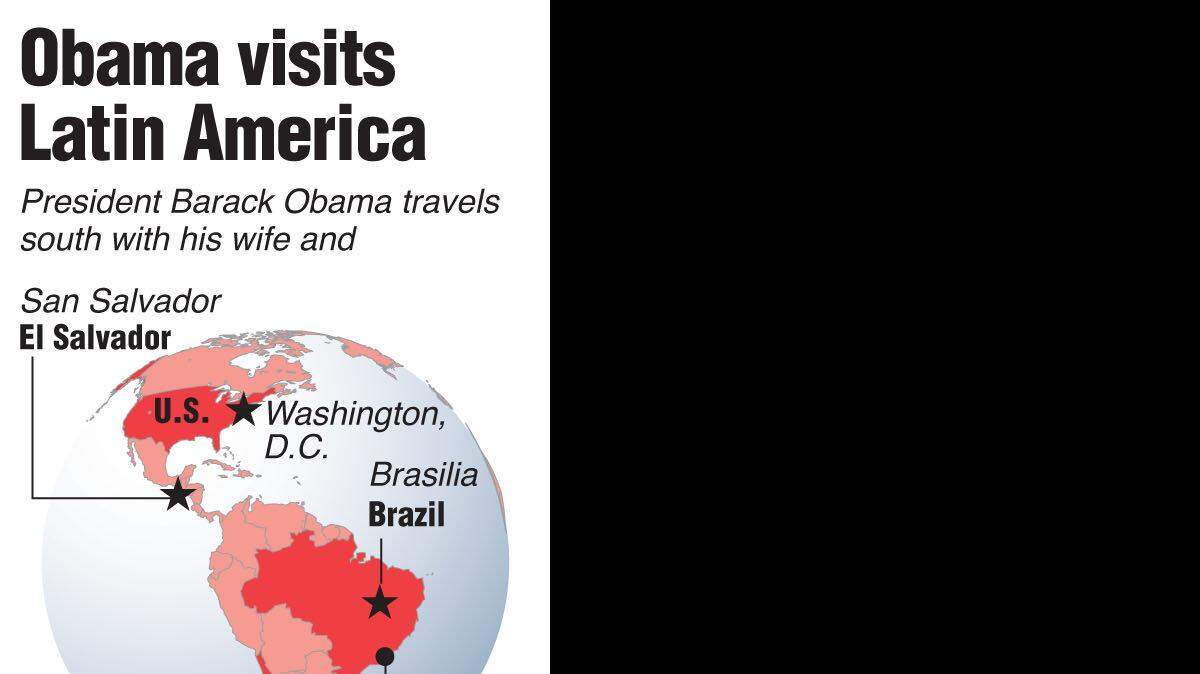
SAN SALVADOR — Fighting a wave of drug-related crime that's sweeping Central America will be among President Barack Obama's top agenda items next week when he arrives in this tiny Central American nation, but neither he nor any U.S. officials will meet with El Salvador's chief public security official.
That's because U.S. diplomats say Public Security Minister Manuel Melgar has "blood on his hands," stemming from the 1985 killing of four U.S. Marines as they dined in this city's upscale restaurant district during the height of this country's civil war.
At the time, Melgar was a guerrilla chief in the Farabundo Marti National Liberation Front, the leftist rebel army that put down its weapons in 1992 and is now part of the coalition government. The U.S. backed the Salvadoran government, which was accused of using death squads to intimidate its opponents.
These days, Melgar wears suits, not khaki rebel attire. He tosses orders to civil servants like his guerrilla underlings once tossed hand grenades. But the fallout from that muggy June evening in 1985 still haunts U.S-Salvadoran relations.
On one side are family members of the U.S. Marines and the U.S. government itself. For them, never forget, even after a quarter century.
On the other side are the realities of El Salvador, where 75,000 people died in the 1980-1992 civil war that took place in the context of the Cold War.
To this day, U.S. diplomats refuse to be seen — or even meet — with Melgar.
El Salvador, however, has largely moved on. A central street through the city bears the name of a guerrilla leader, Schafik Handal. A popular journalist, Mauricio Funes, became president in 2009 at the head of a coalition that includes the once-Marxist FMLN insurgency.
And right-wing forces that once spawned death squads have become less strident, accepting rebels as legitimate political adversaries, just as onetime rebel commanders now tend stores, sit at government jobs and enjoy (gasp!) middle-class life.
Last year, Funes formally apologize to the victims of the war for the "massacres, arbitrary executions, forced disappearances" and other atrocities carried out by the government's security forces.
Melgar's rebel past is well known among El Salvador's 6 million people, and there was barely a ripple when Funes tapped him for the public security post.
U.S. diplomats saw it differently, however, branding his appointment as an imposition of FMLN hard-liners, according to a July 2009 cable released by the WikiLeaks website. His naming froze U.S. law enforcement cooperation as the U.S. Embassy sought guidance from Washington on "how best to work around Melgar," whom it described as "an individual with blood on his hands."
On that June 19, 1985, night, the four U.S. Marines sat at an outdoor table at a Chili's restaurant in the Zona Rosa. All four were unarmed, enjoying down time from guard duty at the U.S. Embassy and wearing civilian clothes.
The seven assailants who arrived in a white pick-up truck were from the Revolutionary Party of Central American Workers, one of the five FMLN factions. Weeks earlier, rebel leaders pronounced that all U.S. military personnel in El Salvador "were legitimate targets in the war," the faction's then-leader, Francisco Jovel, said in an interview.
The assailants fired rapidly. When the shooting ended, Marines Thomas Handwork, Patrick R. Kwiatkoski, Bobbie J. Dickson and Gregory H. Weber, and eight civilians, lay dead.
After the war's end, a 1993 report by a United Nations-mandated Truth Commission took the rebels to task for slaying the Marines, who weren't combatants in the civil war.
"There is no indication whatsoever that they took part in combat actions in El Salvador," the 1993 report said. "The allegation that they were performing 'intelligence functions' has not been substantiated. In any event, carrying out intelligence functions does not, in itself, automatically place an individual in the category of combatant."
What role Melgar played in the attack is in dispute. The U.N. report doesn't mention him, and Jovel, Melgar's guerrilla boss who now works as an analyst for El Salvador's Legislative Assembly, said Melgar had no direct role in the killings.
"Melgar was not there. I can tell you that in the strongest terms," Jovel said. "Officials in the U.S. government have assigned him a role he did not play."
The assertion that Melgar plotted the attack comes from an urban commando chief, Pedro Antonio Andrade, whose testimony is detailed in a report declassified more than a decade ago.
"The Zona Rosa attack was Melgar's idea, said Andrade," a 96-page report by the CIA inspector general's office in 1996 asserted. "Melgar collected information for the attack, including data on the Marines; coordinated with other perpetrators; and designed each team's tasks."
A guerrilla turncoat, Andrade ratted out FMLN weapons caches and was granted immigration parole to live in New Jersey with his wife and children, the CIA report says. The report also says the CIA paid the Andrade family thousands of dollars.
A Department of Justice Inspector General's report also mentions Melgar as someone that Andrade's implicated, but it adds: "Aside from Andrade's statement, we found no evidence in DOJ files of Melgar's involvement in the killings."
Melgar couldn't be reached for comment at the Public Security Ministry, and didn't respond to written questions submitted to his spokeswoman.
Some Salvadorans say the U.S. attitude toward Melgar is hypocritical.
"People . . . who were involved in financing death squads are still guests of honor at the U.S. Embassy," said Carlos Dada, the editor of an online investigative news outlet, El Faro. "Why do they have this double policy?"
Others understand why the issue rankles, even as they warn that pressure to remove him could backfire.
"He serves the democratic interests of the country better than more radical elements of the FMLN," said Juan Ramon Medrano, a former guerrilla commander who has become a centrist political analyst.
Medrano said that if Melgar were ousted, Funes might cede to FMLN demands that he place someone with an even murkier past into the post.
For many Salvadorans, the Zona Rosa massacre has faded into a haze. If Melgar has "blood on his hands," so do hundreds, and maybe thousands, of onetime death squad members and leftist insurgents who now pass each other on the streets.
Of far greater concern is Melgar's capacity to fight runaway gang-related crime and a soaring homicide rate that now averages 16 people a day in a country roughly the size and population of Massachusetts.
"He should not be minister of public security," said Manuel Enrique Hinds, a former economy minister for the right-wing Nationalist Republican Alliance, or ARENA, party. "We are competing for first or second place in the ranking for the highest homicide rate in the entire world."
Jovel, the former guerrilla commander, differs.
If Melgar has a fault, Jovel said, it's that he has balked at tougher methods to deal with organized crime and gangs, rankling those who want a tougher stance.
"They consider him too respectful of human rights," Jovel said.
ON THE WEB
U.S. diplomatic cable that says Melgar has 'blood on his hands'
U.N. Truth Commission Report on El Salvador with details of 1985 Zona Rosa killings
1996 CIA report detailing Melgar's involvement
MORE FROM MCCLATCHY
Clinton probed Argentine leader's nerves, anxiety, stress
Leftist candidate wins El Salvador presidential election
Obama's Latin America trip offers look at changed region
Check out this McClatchy blog: Mexico Unmasked
This story was originally published March 16, 2011 at 3:03 PM with the headline "El Salvador's long-ago civil war still colors U.S. relations."