
Libyan chaos spooks oil markets, raises fear of wider disruption
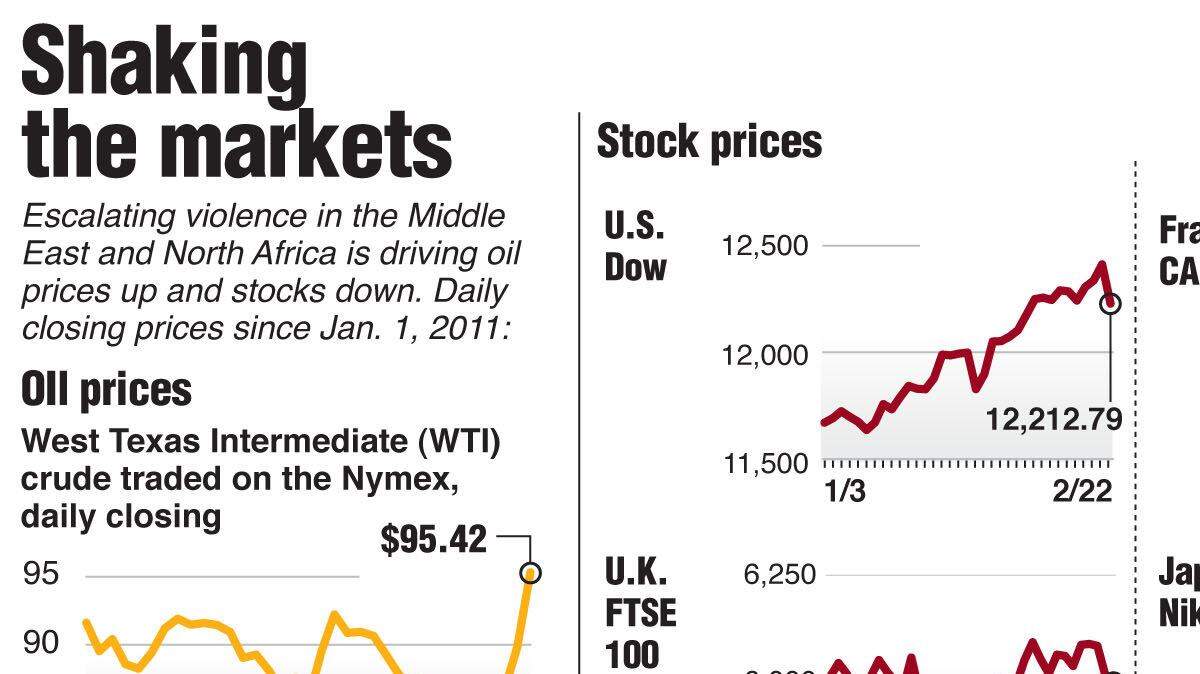
WASHINGTON — Oil prices spiked around the globe Tuesday as traders reacted to the spreading chaos in oil-rich Libya and fretted that a winter of discontent for tyrants also could threaten global oil supplies and the fragile U.S. economic recovery.
The price for a barrel of crude oil for April delivery shot up $5.71 in Tuesday trading on the New York Mercantile Exchange, settling at $95.41, its highest in more than two years. In overseas trading, Brent crude oil on the London Intercontinental Exchange settled up almost half a percentage point at $106 a barrel.
Rising oil prices will have an immediate impact on U.S. gasoline prices, another headache for weary consumers already facing rising food prices amid a sluggish economy.
"You'll probably see the price of gas increase this week because of the unrest," said Troy Green, a spokesman for the AAA auto club.
How much is an open question.
Economists fear that a sustained rise in fuel prices could slow the already plodding economic recovery. A price spike that spans a few weeks wouldn't be problematic, but a sustained hike to $3.50 a gallon or higher would weigh heavily on consumer sentiment.
"Every time oil prices rise it feeds through to consumers. It erodes growth of real disposable income," said Chris Varvares, the president of St. Louis-based forecaster Macroeconomic Advisers. He called the rising fuel prices "another head wind" for the economy.
Forecaster IHS Global Insight projected that a rapid $11-per-barrel increase in the price of crude oil would translate into a 25-cent-per-gallon hike in gasoline prices. The economy would lose almost half a percentage point of growth if prices stayed at that level for a full year, and 270,000 jobs would be lost.
"It would certainly dampen the economic recovery," said Sara Johnson, an economist with IHS Global Insight.
Crude last traded below $80 a barrel on Oct. 19, settling at $79.49. It crossed $90 a barrel on Dec. 23 and since then closed above $90 16 times through Friday, bouncing between $80 and $92 — until this week.
For much of February, oil has fetched a much higher price in Europe than in the United States. This gap reflected the fact that Europe gets a much higher percentage of its oil from the Middle East and North Africa.
But on Tuesday, Libya's unrest changed the equation. It was the first member of the Organization of Petroleum Exporting Countries to teeter on the verge of collapse, and its strongman, Moammar Gadhafi, abrogated his country's oil contracts Tuesday.
"It's exacerbating the situation, and all the more because they are an actual producer and exporter in OPEC. We're watching developments there extremely closely," said John Kilduff, a veteran oil analyst on Wall Street for Again Capital. "The situation is devolving. If you look at the map of the region, you work your way counterclockwise. ... The Saudis are encircled here by countries that are experiencing political turmoil."
Libya exports 1.2 million barrels per day of oil, meeting just a fraction of global consumption. What markets fear is that the spreading unrest could topple regimes in Algeria and Iran and even spill into Saudi Arabia.
Saudi Arabia is the world's largest oil exporter and a key U.S. ally. Much of Saudi oil comes from eastern regions populated by Shiite Muslims, in a country where the rulers are Sunni Muslims. Some of the unrest that's sweeping the Middle East and North Africa_ most notably in Bahrain_ is fueled by Shiite-Sunni animosity.
For now, there's no shortage of oil globally, but reported statistics show that the supply is tightening. The U.S. Energy Information Administration said on Feb. 8 that the world consumed 84.3 million barrels of oil per day last year. Before the unrest spread across the Middle East and North Africa, consumption was projected to increase by 2.4 million barrels per day this year, surpassing the previous record consumption level, set in 2007 before the U.S. economic crisis went global.
Rising prices boost unsavory oil producers and U.S. allies alike.
"The silver lining here is it gives Saudi Arabia and the rest of the oil-producing countries a huge amount of money. It gives them enough money to slow their potential anti-government forces, and that at least keeps them at bay," said Fadel Gheit, a managing director and senior oil analyst for investment adviser Oppenheimer & Co. The Saudis "should be smart enough to know that the world is changing and they better move with it."
If Iran, already facing unrest, were to descend into the kind of chaos witnessed in Libya, that could send oil prices soaring. Iran is the second-largest oil exporter in OPEC, much of its supply going to Asia.
"If that output were disrupted, the Chinese and the Japanese would go out to the global markets. ... We'd be in competition for the much lower oil output," Kilduff said.
Trying to calm fears, the Paris-based International Energy Agency issued a statement Tuesday that said it "stands ready, as always, to make oil available to the market in the event of a major supply disruption if alternative supplies cannot readily be made available via normal market mechanisms."
ON THE WEB
Energy Information Administration February estimates
Center for Strategic and International Studies FAQ on oil risks
MORE FROM MCCLATCHY
Gadhafi remains defiant; Kerry urges re-imposing sanctions
Rally in Texas backs Wisconsin workers
Men fare better as economy recovers, but women suffer
McClatchy's probe into roots of financial crisis, a Pulitzer finalist
To ask a question about this story or any economic question, go to McClatchy's economy Q&A
This story was originally published February 22, 2011 at 5:53 PM.