
Thousands of cameras watch China's Uighurs, inhibiting discourse
URUMQI, China — Looking slowly around his own bedroom, the nervous Uighur man with hunched shoulders said he wasn't sure whether he could speak openly about the Chinese government.
"Someone may be listening on the other side of any wall here," said Anwar, a 50-year-old shopkeeper who didn't want his last name made public. "We must think of our own safety."
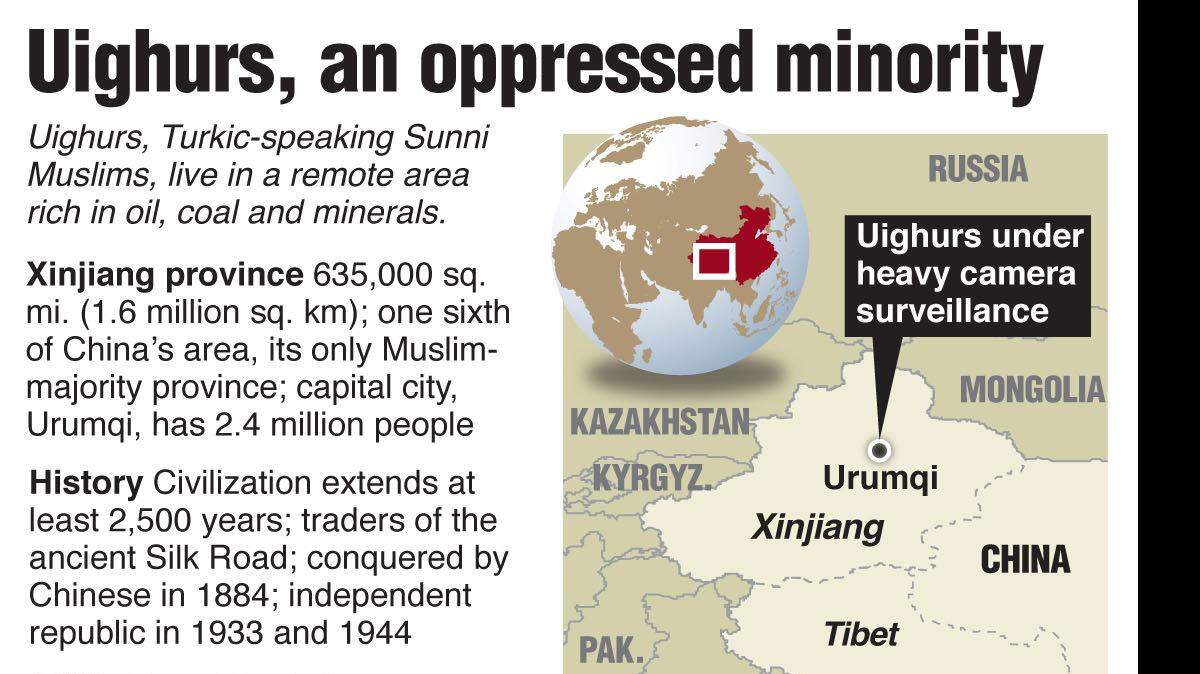
It wasn't idle concern. Chinese officials added nearly 17,000 surveillance cameras last year to the tens of thousands already installed in Urumqi, apparently centered on neighborhoods frequented by Uighurs, a Turkic-speaking Muslim minority. They recently announced plans to put the entire city of some 2.4 million people under "seamless" observation with tens of thousands more.
During the past several weeks of protests in the Arab world, some Western observers have sought to draw parallels between the scene in Cairo's Tahrir Square and the one at Beijing's Tiananmen Square in 1989, when military gunfire mowed down crowds demanding political reform in China.
Would it be possible, they wondered, for that sort of unrest to spread again in China?
While the details are different in many ways, the plight of the Uighurs in Urumqi makes it clear that Chinese officials spent the past two decades honing authoritarian social control strategies, both blunt and sharp, to be sure that doesn't happen.
Perhaps more than any other corner of China, the city is now a showcase of the police state tactics that the country's rulers use in tandem with economic growth to maintain their vision of "harmonious" society.
Like most Uighurs in this city on the edge of China's western expanse, Anwar was afraid of saying the wrong thing and being dragged off by police, who are usually members of the country's majority Han Chinese population.
After riots between Uighurs and Hans in the summer of 2009 left almost 200 people dead, according to official statistics, the Chinese government launched a combination of severe crackdowns and information-gathering that targeted Uighurs of all walks of life.
"The ability and scale of this new surveillance is unparalleled. ... Police can take away and 'disappear' people at any time," said Nicholas Bequelin, a Hong Kong-based researcher for Human Rights Watch's Asia division. "It is an area where the political repression is the most severe of any part of China."
When Anwar leaves the two-room house that he tries to keep warm with a coal stove and rugs on concrete walls, there's no question in his mind that he could be under watch.
Across Han-dominated areas, where luxury hotels and slick office buildings do big business, the cameras appear to be fewer in number. Local Uighurs fear it's a hint of things to come: a prosperous region meant for Han Chinese, not Uighurs.
In 1949, the Han made up less than 7 percent of the population of the Xinjiang area, which includes Urumqi, and Uighurs composed more than 75 percent, according to state statistics. Due in large part to government relocation efforts, Uighurs now have less than half of the region's population; they barely maintain a numerical edge over the Han in Xinjiang as a whole and are vastly outnumbered in Urumqi.
The 2009 riots, a Uighur rampage followed by a violent Han backlash, seem to have created even more support among the Han here for government supervision of Uighurs. Their resentment is compounded by their widespread perception that Uighurs don't appreciate the enormous government investment in Xinjiang's infrastructure. For example, more than $4.5 billion is slated just for airport construction through 2015.
While the Han interviewed in the city say the atmosphere improved after the arrests or detentions of well more than 1,500 people after the bloodshed, they still worry that "separatist" elements in the Uighur population could make more trouble.
"Compared with before, we feel less safe," said Cai Jinbao, a Han clothing merchant who moved to Urumqi 18 years ago from the coastal province of Zhejiang, which is on the other side of the country. "I couldn't tell you when the markets close at night. I don't go out much in the evening anymore."
Along with thick clusters of cameras in Uighur neighborhoods, an epicenter of the rioting, there are now patrols by police in five-person formations with riot shields, shotguns and compact assault rifles. The monitoring of phone calls, text messages and Internet activity is, even for China, intense.
"The Han officials don't want to see Uighurs," said Abdulrahman, a 37-year-old driver who, as with many other Uighurs, preferred that his family name not be revealed. Before continuing the conversation, he emphasized how dangerous it was to speak about his experience.
"We're worried about being monitored. There are cameras everywhere," he said, tapping his hands together nervously. "If we talk, we will be arrested."
Some Uighurs were less hesitant to speak their minds, however.
Mehmet, a 40-year-old with a tan face and flat nose, said he was now convinced that "the aim of the government is to remove Uighurs from the city."
"It's possible there will be more violence. I worry there could be an even bigger dispute," said Mehmet, who was vague about his position in the Uighur community but was introduced by an intermediary as having deep religious convictions and who was treated with deference by others. "The government is watching Uighurs very closely. It's creating a very serious problem between ethnic groups."
Throughout the post-2009 period, the government has continued to bulldoze Uighur neighborhoods in the city and surrounding Xinjiang. Officials say they want to modernize the housing stock, but Uighurs and human rights analysts suspect an effort to break up Uighur population centers as more Han Chinese arrive in the area.
To the west of Urumqi, a large group of Uighurs is building houses next to a road that leads to a garbage dump, on the side of a small hill that has no water or electricity. Some of the men melt snow on garbage drums to make water for cement mix.
"They want us to live by the garbage," said Kurban, a burly 38-year-old whose Urumqi home, in a neighborhood where he played as a child, was torn down in 2006. "What can we do? Talking means nothing."
Corinna-Barbara Francis, a senior China researcher for Amnesty International, noted that there are concerns about an "ethnic restructuring" of Urumqi.
"Uighurs are removed from their neighborhoods and at best they're resettled outside the city," she said. "In some cases, it can be far outside the city."
Francis added: "If you take all of those things together it's quite disturbing. ... The government is clearly trying to use sheer force and intimidation."
Attempts to get comment from Urumqi officials for this story, by fax and telephone, were unsuccessful.
One Uighur who's now living in the far south of Urumqi said that when his home of 20 years closer to the center of the city was demolished last year, "the government sent people to our neighborhood and they told us to leave Urumqi and go back to our home villages."
Wearing black corduroy pants and a dark jacket, the 36-year-old food vendor, whose first name is also Mehmet, sounded angrier the longer he spoke.
"The government," he said, "is trying to scatter Uighurs in every direction."
MORE FROM MCCLATCHY
Follow China developments at McClatchy's China Rises blog
Follow Tom on Twitter
Death in China: Crushing dissent or tragic accident?
Nobel awarded to empty chair as China keeps dissidents quiet
China's dark side: On Yellow River, corpses mean cash
60 years after revolution, ethnic tension still plagues China
This story was originally published February 16, 2011 at 2:02 PM with the headline "Thousands of cameras watch China's Uighurs, inhibiting discourse."