
Muslim births to outnumber Christian births worldwide by 2035
Muslim births are currently set to outpace Christian births with in 20 years, a new Pew Research Center analysis shows.
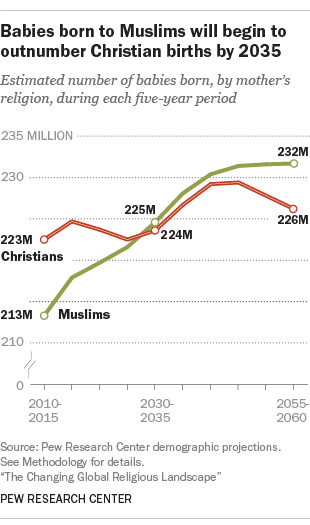
Although Christian mothers currently give birth to the majority of the world’s children, by 2035 Muslim mothers will have taken over. They are projected to be the fastest growing of the world’s major religious groups. Christian births represent 33 percent of the world’s babies, while Christians are 31 percent of the population as of 2015. But Muslim mothers birthed 31 percent of the babies born between 2010 and 2015, outpacing the Muslim share of the world’s population, at 24 percent.
As of 2015, there were 2.3 billion Christians, 1.8 billion Muslims and 1.2 billion unaffiliated people. There were 1.1 billion Hindus, 500 million Buddhists and 14.3 million Jews.
Muslims have a relatively young global population and high fertility rates. By 2035, estimates suggest there will be 225 million babies born to Muslims while only 224 million born to Christians. The world’s Christian population will still be larger.
The Pew analysis of the data does not assume babies will grow up to be members of the religion practiced by their mother. It takes into account the practice, particularly in the U.S., of adults leaving their family religion and switching to another, or practicing no faith at all. This trend indicates that absent other factors, there will be a global decrease in the Christian population, an increase in people affiliated with no religion, and a small increase in the Muslim population.
But once fertility and mortality rates are taken into account, numbers change: Data suggests the share of unaffiliated people will decline while Muslims increase and Christians increase at a slower rate. The entire global population is expected to increase to 9.6 billion, a jump of 32 percent.

The number of Muslims will increase by 70 percent while the Christian population will only grow 34 percent. Much of that growth is expected to take place in sub-Saharan Africa, which has high populations of both groups. The number of religiously unaffiliated people will be impacted by the fact that many religious nones live in North America, China, Japan and Europe, all places with low fertility rates and aging populations.
The median age of the world’s population is 30, so religious groups that have a younger group of adherents will experience more growth. The median age for Muslims is 24 and for Christians it is 30.
This story was originally published April 6, 2017 at 4:46 PM with the headline "Muslim births to outnumber Christian births worldwide by 2035."