
Tax-cut deal could be good for economy — with a big 'if'
WASHINGTON — This week's tax-cut compromise would contribute almost $1 trillion to the nation's federal budget deficit over the next two years and add sharply to the mounting national debt, yet the U.S. Chamber of Commerce and mainstream economists cheered it.
Why? It's a question of timing.
The deal, proposing roughly $900 billion in lost revenue to the Treasury, came days after a special bipartisan deficit-reduction panel warned last Wednesday that the nation is on a path to fiscal ruin if it can't get deficits and debt under control over the next decade.
The debt commission's alarming warnings followed November's midterm elections, when polls showed that the deficit was a primary concern of tea party backers and independent voters.
Yet President Barack Obama and congressional Republicans have teamed up to propose adding another $900 billion to the budget deficit and debt.
Confusing? Despite the apparent contradiction, most experts think that adding to the deficit over the next year or two won't worsen the problem if — and it's a big if — Washington puts the nation on a path to tame the debt in ensuing years.
"If they can come up with a better system within two years, that may be entirely consistent," said Diane Lim Rogers, the chief economist for the Concord Coalition, a bipartisan group dedicated to balanced federal budgets.
"It's not going to work out well if this is just another kicking of the can down the road and two years from now we just extend them again. If it weren't for the fact that these (debt) commissions have issued reports, I'd be much more cynical. It gives me more hope that two years down the road policymakers will not get away with the notion that this is an OK thing to do," Rogers said.
In a news conference Tuesday, Obama addressed the apparent contradiction between the long-term need to reduce budget deficits and his proposed deal, which would add to them for two years. He explained that the economy needs a jolt to push its slow-growth trajectory into a more robust recovery.
"The economy is not growing fast enough to drive down the unemployment rate," the president said.
Obama and his Republican partners are betting that a short-term rise in the deficit will help get the economy on a faster-growth path in two ways: eliminating fear that expiring tax cuts will result in higher taxes, along with reducing the wage tax and giving businesses other tax incentives to spend in 2011.
"One is the removal of a major obstacle to growth, which is the extension of tax cuts. Most economists thought that if taxes go up it could really hurt growth. And you really added some net new stimulus," said Nariman Behravesh, the chief economist for forecaster IHS Global Insight. "That's going to help growth a little bit, adding half a percentage (point) of growth for a few quarters. ... With the economy still struggling, every little bit helps."
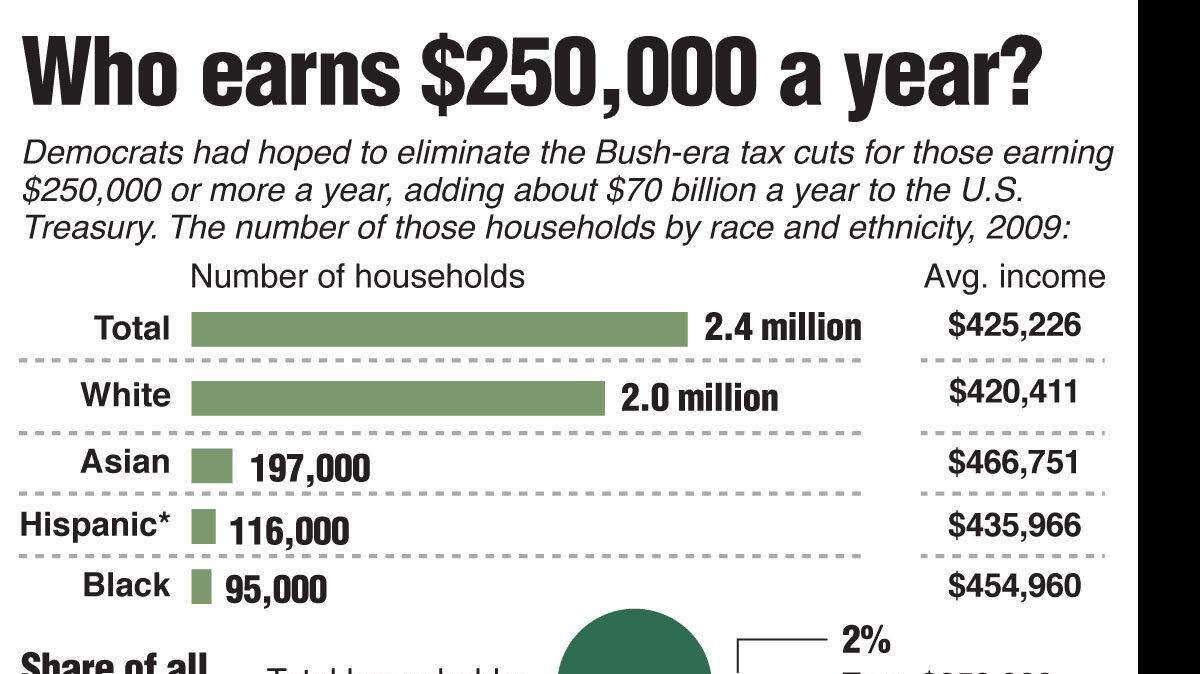
There's little evidence that extending the tax cuts for the wealthiest 2 percent of Americans would boost economic activity significantly, but pushing off the threat that tax rates might rise for two years helps reduce uncertainty.
That's one reason that business groups such as the U.S. Chamber of Commerce applauded.
The deal "will go a long way toward helping our economy break out of this slump and begin creating American jobs," chamber Executive Vice President Bruce Josten said.
Other experts offered more qualified praise.
"I think the compromise is mainly about avoiding 'contractionary' policies, and not so much a new thrust to economic activity," said Rudolph Penner, who directed the nonpartisan Congressional Budget Office from 1983 to 1987. "The one exception to that is the payroll tax holiday."
That proposal for a one-year wage-tax holiday would lower the 6.2 percent of income that all workers contribute to Social Security by 2 percentage points. That'd cost the Treasury about $120 billion in lost revenue, according to White House estimates, which would be covered by borrowing, adding to the deficit. It'd replace the president's Making Work Pay credit, a partial payroll tax credit this year for some workers that was heavy on paperwork.
"It's bigger (than the current credit) and therefore probably gives you a net stimulus," Penner said. "Whether it's all worth it, I think, is an incredibly complicated question."
Complicated not least because the deficit, which was viewed as a threat to the nation's future just a week ago, would go up sharply over the next two years under the framework. That's not such a big deal if Washington enacts the nearly $4 trillion in proposed savings that the bipartisan deficit-reduction commission's report laid out last Wednesday, or something like them. The report recommends a radical overhaul of the tax code to create only three tax brackets and eliminate $1.1 trillion in tax breaks.
"It is so badly needed that if this was a trade for fundamental tax reform, I'd say it's all worth it. But if nothing happens to improve the tax system as a result of this, then we haven't accomplished much," Penner said.
At his news conference Tuesday, Obama said he'd pursue a sweeping tax-code overhaul in the years ahead, but first, he said, this deal is needed to stabilize the weak economy.
A number of the tax credits to be extended as part of the compromise would flow directly into the economy, and quickly. These include unemployment insurance benefits, which would be extended for 13 months, adding $56 billion to the deficit. Economists like unemployment benefits because the recipients spend them almost immediately, thus they translate quickly into economic activity.
Additionally, a host of other refundable tax credits aimed at low-income and middle-income workers are expected to provide a quick economic boost.
"These are relatively small-dollar amounts, but still they're highly effective as stimulus," said Chad Stone, the chief economist for the Center on Budget and Policy Priorities, a liberal research group.
The tax credits and unemployment insurance would be temporary and thus "they don't get built into the long-run budget deficit," Stone said.
The extended tax cuts, too, would be temporary.
"The advantage of this is at least it's not a permanent extension of any portion of the Bush tax cuts. My feeling has been the danger was in never letting go of the Bush tax cuts," said Rogers, of the Concord Coalition.
MORE FROM MCCLATCHY
Democrats could scuttle Obama-GOP tax cut deal
Obama: Tax cut deal is best Democrats can hope to get
Bank of America settles with states, feds in fraud probe
South Korea trade deal delivers Obama a victory
For more McClatchy politics coverage visit Planet Washington
McClatchy's probe into roots of financial crisis, a Pulitzer finalist
To ask a question about this story or any economic question, go to McClatchy's economy Q&A
This story was originally published December 7, 2010 at 6:06 PM.