Why was Pelosi’s Taiwan trip a big deal? Here are three reasons, according to experts
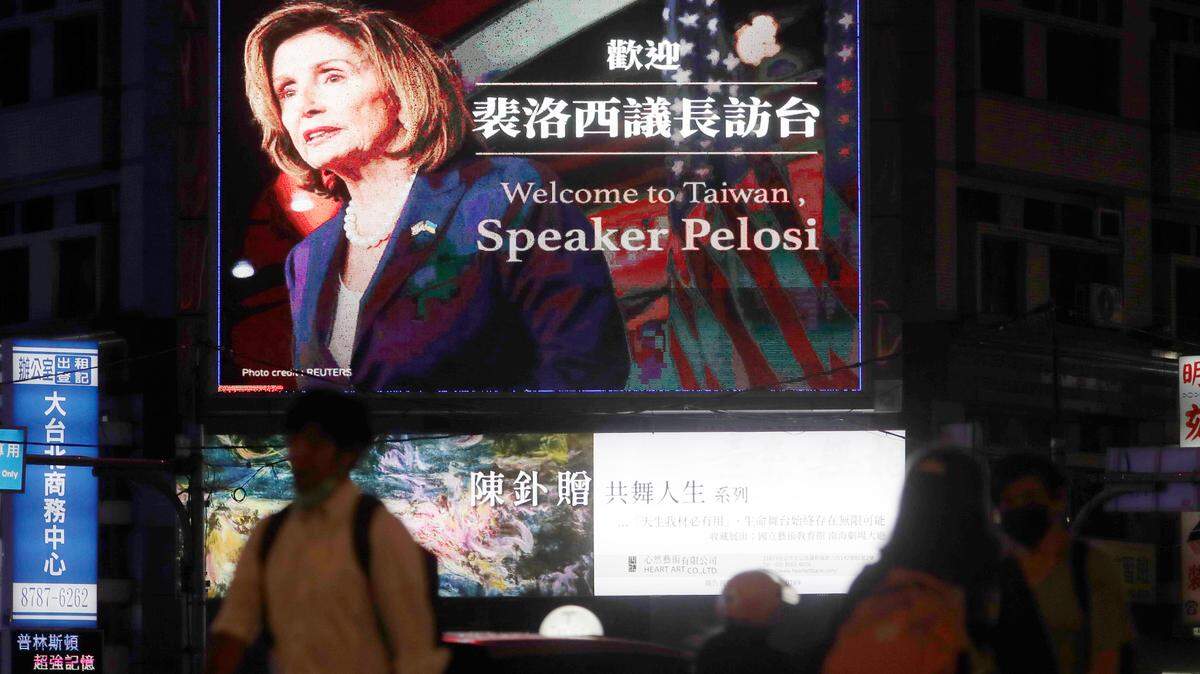
During a trip to Asia, House Speaker Nancy Pelosi and a congressional delegation visited Taiwan, a visit met with extensive commentary, domestic debates and backlash from China.
Millions of people followed Pelosi’s flight to Taiwan, an island nation of 23 million people off the southeast coast of China, on a live tracking site – so many that the site almost crashed, Buzzfeed News reported.
But why was her visit such a big deal?
#1: Pelosi is the highest-ranking U.S. politician to visit Taiwan in 25 years after earlier high-profile visits led to gunfire
As Speaker of the House, Pelosi is third in the presidential line of succession, after the president and vice president, and “the Chinese take that very seriously,” Susan L. Shirk, chair of the 21st Century China Center at UC San Diego, told CNN.
Her visit is the first of its kind since the late 1990s yet conditions in recent years are “largely as they were in the mid-1990s,” writes Michael Mazza, a senior non-resident fellow at the Global Taiwan Institute, when another high-profile visit triggered the Third Taiwan Strait crisis.
In 1995, the then-president of Taiwan visited the U.S. to attend a reunion at Cornell University, Mazza said. China criticized the visit and tensions escalated.
Within a year, shots were fired as China launched missiles into Taiwan’s waters and across its capital city, Taipei, Mazza explained. The U.S. sent aircraft through the Taiwan Strait in a show of force. “There was really nothing China could do,” University of Sydney professor Jingdong Yuan told Axios.
Jump forward to present day: Pelosi’s visit has drawn threats of retaliation from China, News Nation reported.
China’s response “will almost certainly include a military component,“ M. Taylor Favel, Director of the Security Studies Program at Massachusetts Institute of Technology, wrote on Twitter. The response will include “live fire exercises, a much greater military presence within the Taiwan Strait” – “even missile tests” – as well as “economic and diplomatic actions,” he said.
But why? Why is China displaying military force against Taiwan?
#2: China views Taiwan as part of its territory – even though Taiwan is a self-governing democracy that views itself as independent
The history between China and Taiwan is a long and complicated one with a few key milestones that are relevant today.
In 1949, China’s internal political disputes led to the creation of two Chinese governments: one on the island of Taiwan and one on the mainland in Beijing, Reuters reported.
Ever since, Taiwan has been governed independently even as China has continued to view Taiwan as part of its territory, Council of Foreign Relations Asia expert Lindsay Maizland wrote.
“Beijing has vowed to eventually ‘unify’ Taiwan with the mainland, using force if necessary,” Maizland said.
To navigate this will-the-U.S.-do-anything-if-China-invades-Taiwan question, the U.S. adopted a policy of “strategic ambiguity,” Maizland said. .
‘Strategic ambiguity’ means, according to Maizland, that the U.S. “will maintain the ability to come to Taiwan’s defense, while not actually committing to doing so.”
So does the U.S. consider Taiwan its own sovereign country? That question highlights one more reason why Pelosi’s visit to Taiwan is a big deal:
#3: The U.S. and Taiwan have no official diplomatic ties, just unofficial ones
Woven into the complicated question of whether or not the U.S. will defend Taiwan against a Chinese invasion there is another equally complicated question: Is Taiwan its own country or is it part of China?
To navigate this question about Taiwan’s status, the U.S. adopted a “one China” policy, Bonnie Glaser, a senior advisor for Center for Strategic and International Studies writes.
According to the State Department, this means that, “We oppose any unilateral changes to the status quo from either side; we do not support Taiwan independence; and we expect cross-Strait differences to be resolved by peaceful means.”
Since the U.S. recognizes only ‘one China’ – namely the Chinese government of Beijing –, the State Department says it does not have an official diplomatic relationship with Taiwan, just a “robust unofficial relationship.”
Pelosi and her delegation flew right into the center of the controversial and complicated questions surrounding the triangle of foreign relations between the U.S., China, and Taiwan. Her delegation met with Taiwan’s President, Vice President, Foreign Minister, and other members of Parliament, according to a statement released to McClatchy News on August 3.
According to Pelosi, the visit “should be seen as a strong statement that America stands with Taiwan.”
As a Brookings senior fellow of Foreign Policy, Ryan Hass, writes, “Each of the main players — China, Taiwan, and the United States — believe it is acting prudently to protect its interests in the face of escalatory actions from the other side of the Strait.”