
Supreme Court reviews whether parts of 1965 Voting Rights Act are out of date
The politically charged issue of race was before the U.S. Supreme Court on Wednesday in a case that could determine how the landmark 1965 Voting Rights Act applies to the South.
The nine justices engaged in a lively and at times contentious 70-minute exchange, with several possibly signaling their positions in what may mean a new chapter in the nation’s divided racial history. The repercussions of their eventual decision could be felt throughout the country.
“Is it the government’s submission that the citizens in the South are more racist than citizens in the North?” Chief Justice John Roberts asked in an apparently facetious question that drew gasps from the audience.
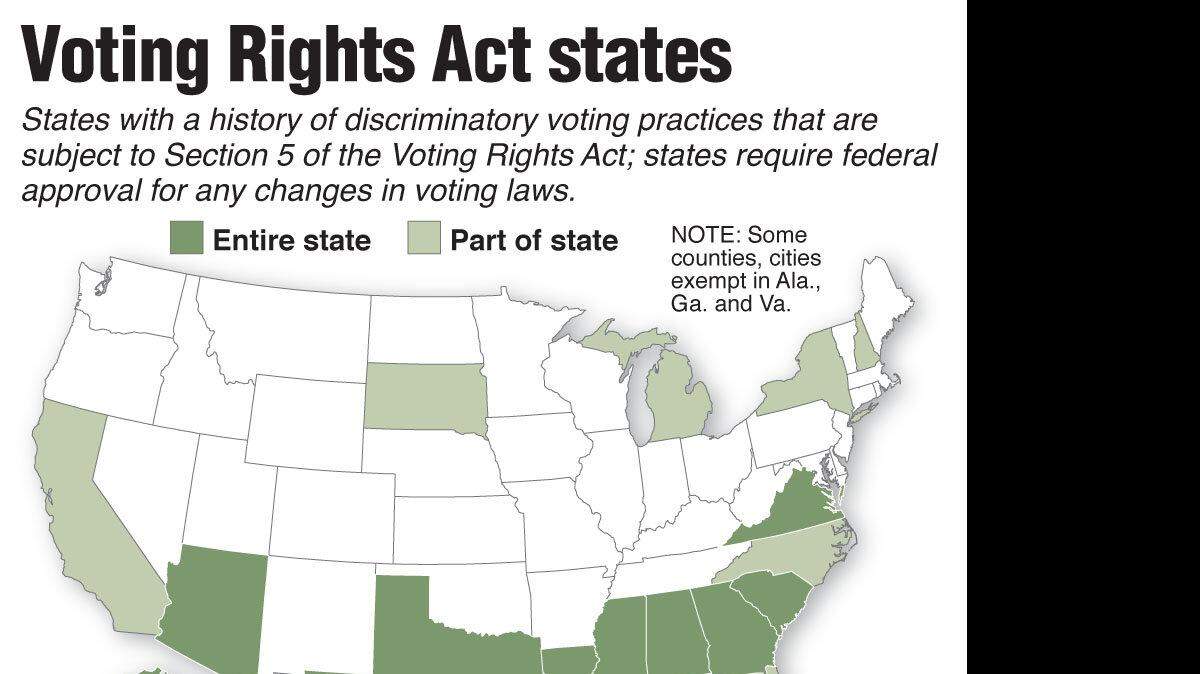
The case arose out of Shelby County, Ala., which is challenging sections of the pivotal 1965 law that prohibited discriminatory voting rules. The county brought the suit against the sections of the law that require nine mostly Southern states and portions of seven others to receive prior approval from the U.S. Department of Justice on voting procedures or anything that affects a minority group’s ability to cast ballots.
The nine states currently covered in their entirety under the contested sections are Alabama, Georgia, South Carolina, Texas, Alaska, Arizona, Louisiana, Mississippi and Virginia. The seven others are California, Florida, North Carolina, Michigan, New Hampshire, New York and South Dakota.
Several of the states are engaged in legal disputes with the Justice Department on Voting Rights Act clearance issues, such as Texas’ ongoing fight over drawing district lines.
The hearing drew well-known African-American leaders, including the Rev. Jesse Jackson, the Rev. Al Sharpton and several African-American members of Congress. Among them was the House Democrats’ assistant leader, Rep. James Clyburn of South Carolina.
The court’s ideological lines were immediately obvious as Justice Sonia Sotomayor challenged Shelby County’s attorney, Bert Rein.
“Some portions of the South have changed,” said Sotomayor, who then cited an ongoing pattern of discriminatory voting procedures in Shelby County. “Your county pretty much hasn’t. You may be the wrong party in bringing this.”
Rein argued that applying Section 5 of the law to only certain states violates the Constitution, which is based on laws being applied equally. He said that the formula to determine which jurisdictions fall under Section 5 is outdated, based on long-since discontinued literacy tests and voting registration dependent on mid-1960s data.
At the center of the case is whether the courts or Congress, which in 2006 reauthorized the Voting Rights Act for 25 years, should decide whether the prior approval requirement in Section 5 – considered by supporters to be a deterrent to discrimination – stays in place.
U.S. Solicitor General Donald Verrilli pointed out that Congress had looked at the record and approved the law by large margins. But Justice Antonin Scalia said, “I think it is attributable to a phenomenon that is called perpetuation of racial entitlement.”
Scalia said that he did not think Congress would ever change the law, but the courts should.
“Even the name of it is wonderful: the Voting Rights Act,” he said, emphasizing that politicians had no incentive to alter it. “Do you think that the right to vote is a racial entitlement in Section 5?”
Justice Elena Kagan said that deciding which states were engaged in discriminatory voting activities would be “a new power” for the judges.
“I don’t think this falls under our bailiwick,” she said.
But the issue of applying the law equally to the states and jurisdictions seemed to resonate with several justices.
Carrie Severino, chief counsel of the Judicial Crisis Network, a conservative legal advocacy group, said that Congress should have updated the 1960s voting statistics used as a basis in the formula for Section 5 compliance.
At least five members of the court seemed to agree that it is constitutionally impermissible, in the words of Justice Anthony Kennedy, to treat some states as “independent sovereign(s)” and others as “under the trusteeship of the United States government” without actual, current evidence in a distinction between these states.
Kennedy is seen as the swing vote in many closely divided cases.
But feelings also ran strong among African-Americans.
About 15 members of the 42-member Congressional Black Caucus held a rally in front of the Supreme Court building before the arguments to urge the court to keep the Voting Rights Act intact.
“We still have blatant and subtle impediments to voters,” said Sherrilyn Ifill, president and director-counsel of the NAACP Legal Defense Fund, which was part of the case against Shelby County.
She cited last-minute polling place changes to locations outside the community, elimination of early voting days and the outright canceling of elections as obstacles faced by minorities.
The tension over the Voting Rights Act came together for Clyburn, who, after attending the court hearing about the Alabama case, crossed the street to the U.S. Capitol to speak at the presentation of a statue honoring Alabama native Rosa Parks. By refusing to give up her seat to a white man on a Montgomery bus in 1955, she is credited with launching the civil rights movement.
“One hour ago, I sat across the street witnessing the opening arguments of a voting rights case before the United States Supreme Court, a case that many feel could turn the clock back on much of the progress that has been made, and for which we pause today to honor Rosa Parks,” he said.
This story was originally published February 27, 2013 at 1:28 PM with the headline "Supreme Court reviews whether parts of 1965 Voting Rights Act are out of date."