
Former N.C. speaker gets 5-year sentence
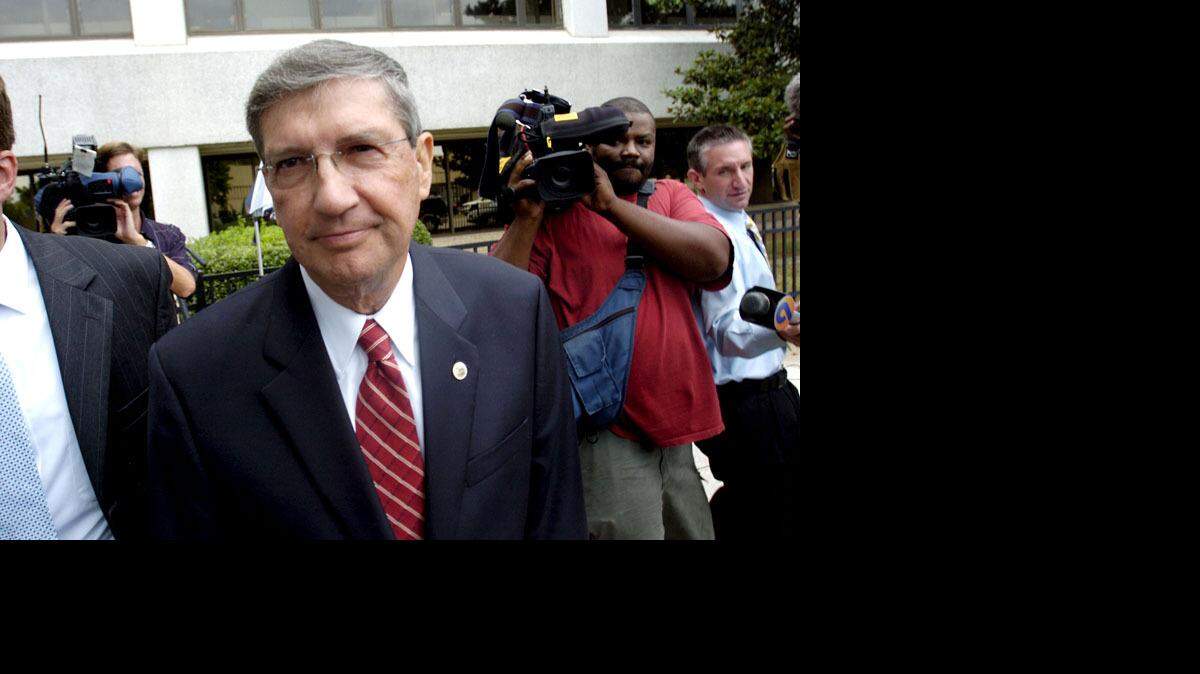
RALEIGH, N.C. — He looked like the old Jim Black as he walked into the federal courtroom Wednesday morning. A confident smile on his face, the former North Carolina House speaker from Mecklenburg County even patted the forearm of one of the federal agents who helped bring him down.
But Black's smile soon faded as his sentencing hearing on a public corruption charge progressed. It became clear that Black, an optometrist, was not going to be allowed to open a free eye care clinic as he had suggested to help pay his debt to society. Nor would he get the lesser sentence his attorneys had suggested of roughly three year behind bars.
Black winced and covered his face in his hands as U.S. District Judge Terrence Boyle determined that Black should serve almost double that. Boyle spared him a tongue lashing, but ordered that Black spend five years and three months in federal prison for accepting $29,000 in cash payments from chiropractors while pushing legislation that would be favorable to the profession. Boyle also fined Black $50,000.
The sentence means that Black, 72, with an ailing wife, could die behind bars. But Boyle found that Black's actions constituted bribery and that he had not shown true acceptance of responsibility for his criminal behavior.
"Today is the end of the line for Jim Black and his corruption," U.S. Attorney George E.B. Holding said after the sentencing. "Speaker Black is going to prison for 63 months. He earned every day of it."
Gov. Mike Easley, who relied on Black to push several of his initiatives through the legislature, said he was saddened by what had happened.
"I think the whole episode is unfortunate," Easley said. "It's sad. It's a shame his career ended that way. It's a shame for North Carolina. It's just a sad day, and I'm glad we got it behind us. And I think we just move on and concentrate on the budget now and just keep moving North Carolina forward."
Black and his attorneys declined to comment after they left the courthouse in Raleigh. They piled into a black SUV driven by Black's son, John, the only family member to attend, and drove away. Where Black will serve and when has yet to be determined.
Black still also has to appear in state court to be sentenced on bribery and obstruction of justice charges that could result in anything from probation to another two years in prison. A date has yet to be set.
Black, one of the state's two longest-serving speakers, is the most powerful official in the state's history to be sentenced for public corruption. He joins a growing list of other officials - such as former N.C. Agriculture Commissioner Meg Scott Phipps and former U.S. Rep. Frank Ballance - to be put behind bars in recent years for taking advantage of their public positions. All are Democrats in a state largely controlled by Democrats.
But Black's case is likely to be remembered as a watershed moment in North Carolina politics, said Harry Watson, a University of North Carolina-Chapel Hill history professor who oversees the Center for the Study of the American South. Black rode to power by embracing the rise of big money politics in North Carolina, and in the end, he showed how dangerous that game can be, Watson said.
"The dark underside of the story is that even in a state where honest government has been a standard that the influence of money in politics is now so pervasive that the temptation to indulge in this kind of thing is enormously powerful," Watson said.
During the sentencing hearing, Black downplayed the severity of his crime. In his trademark mumbling voice, Black said he accepted "full responsibility for the mistakes I have made." He also called his actions "stupid," and apologized to his colleagues in the legislature and the people of North Carolina.
Black and his lead attorney, Ken Bell of Charlotte, insisted that the only crime Black committed was taking cash campaign contributions from chiropractors that he failed to document in his campaign reports. Each payment was no more than $4,000, the legal limit for campaign contributions, though state law does not allow them to be given in cash.
"If he were a federal official it would be a misdemeanor," Bell said.
But Boyle agreed with many findings by John Wasco, a senior federal probation official, who developed sentencing recommendations for Black. Wasco found that Black's conduct was much closer to bribery than accepting illegal gratuities. He noted that Black tried to hide his cash dealings with the chiropractors, which took place in restaurant bathrooms, and tried to convince them to lie to cover their tracks.
Federal prosecutors John Stuart Bruce and Dennis Duffy also told Boyle that Black has not cooperated with the investigation in accordance with his plea agreement. They said he only disclosed that a lobbyist had given him a $500,000 loan in 2000 after they had asked questions about it.
"Powerful men are not above the law and that's what the court's sentence should say," Bruce said.
Boyle spared Black a harsher sentence, by choosing not to consider the money and other perks that he gave to former Rep. Michael Decker as relevant criminal conduct. In early 2003, Black gave Decker $50,000 in cash and checks after Decker switched parties and backed Black for speaker, keeping him in power as part of a coalition government co-led by Republican Rep. Richard Morgan.
Decker has been sentenced to four years in prison for accepting the bribe. Black has admitted to a state bribery charge in that case, but has entered an Alford plea, which means he only pleaded guilty because he saw it as the best option available.
The sentencing drew several Republican leaders, including state GOP Chairwoman Linda Daves and former state lawmakers John Rhodes of Mecklenburg County and Fern Shubert of Union County. Rhodes was a constant critic of Black, and he was one of the few attendees who said the former speaker should have gotten more time.
"The sentence was light, based on the damage to the institution of the House of Representatives," Rhodes said.
Another former lawmaker, Democrat Parks Helms, now a Mecklenburg County commissioner, said the sentence was too harsh.
"Yes, he needed to be punished," Helms said of Black. "But the circumstances didn't fit the crime."
The scandals that swirled around Black for the past two years led to much tougher ethics, lobbying and campaign finance laws. Some say there's still room for improvement - open ethics commission hearings, a ban on lobbyists helping to raise political money and term limits for the House speaker and the Senate president pro-tem, among others.
"Certainly we would be very hopeful that folks would see there is a renewed need to take a look at these reforms," said Louisa Warren, director of the N.C. Coalition for Lobbying and Government Reform. "There's room for more."
___
(McClatchy Newspapers correspondents Ryan Teague Beckwith and Jonathan Cox contributed to this report.)
This story was originally published July 11, 2007 at 12:54 PM.