For bribery-riddled Odebrecht, corrupt profits weren’t enough. It craved tax breaks, too
As bribery investigations were galloping in the United States and globally, Brazilian engineering giant Odebrecht in 2015 quietly registered new companies in the tiny tax haven of Luxembourg, known until recently as a safe harbor for those seeking or needing secrecy.
Less than a year later, the Department of Justice announced that Odebrecht had agreed to a breathtaking plea deal. Executives acknowledged paying a staggering $788 million in bribes to win business, through a special Structured Operations division, whose executives at one point moved to Miami to avoid the figurative heat.
Odebrecht lawyers agreed to pay $2.6 billion, a record settlement under the United States’ Foreign Corrupt Practices Act.
Nowhere in the 74-page plea deal was there any reference to Luxembourg. The focus was on Switzerland, Luxembourg’s larger rival in the business of secrecy and banking.
But a new global collaborative reporting project called OpenLux, which reveals a non-public registry of true owners of companies in Luxembourg, is now filling in blanks in the still-unfolding story of how Odebrecht reaped millions in profits thanks to corruption across Latin America and Africa.
It’s a tale of how an admittedly crooked company hid in plain sight, moving to Luxembourg, on paper, some of its operations involved with some of the most egregious illegality. Some of the names of the individuals on the Luxembourg companies are also associated with the bribery, although not all were criminally charged. It all muddied the trail for prosecutors in pursuit while allowing Odebrecht to maximize its illegally won business through aggressive, albeit legal, tax avoidance.
Odebrecht competed for business against U.S. oil and engineering companies, which are prohibited from paying bribes by the Foreign Corrupt Practices Act.
The story remains an important one because of how bribery empowered and sustained corrupt governments, undermined U.S. foreign policy interests, enriched those who rule over societies of great inequity and weakened a growing global move toward transparency.
Luxembourg knew at the time that Odebrecht was under international investigation. Its public prosecutor’s office confirmed in a statement to McClatchy and the Miami Herald that it cooperated with Brazilian investigators’ inquiries — called rogatory letters — about Odebrecht’s new European businesses.
“These letters rogatory — which date from 2014, 2015 and 2017 — were executed and returned with the necessary information to the Brazilian authorities,” said the statement.
U.S. prosecutors, focused on the behavior of some Odebrecht executives who resided temporarily in South Florida, were not focused on Luxembourg shell companies and bank accounts over the period from 2015 to 2017. They were interested in Odebrecht operations in Ecuador and Venezuela and how those tied to South Florida.
“We were looking at Odrebrecht’s country managers [in the United States] and their use of the U.S. banking system,” said a federal law enforcement official familiar with the investigation of bribes paid out of Miami to foreign contractors. The official spoke on condition of anonymity because of ongoing related prosecutions.
U.S. court-ordered monitoring of Odebrecht’s finances ended last November. The following month Odebrecht announced it had rebranded itself as Novonor. It even gave itself a new motto, “Inspired by the future.”
Odebrecht’s U.S. subsidiary, the holder of airport construction contracts in Miami, wasn’t implicated in the bribery.
Dogged by past
At least 13 companies with the Odebrecht name appear as incorporated firms in Luxembourg’s corporate registry, many of them created in 2015 and 2016, a period when the company was engulfed in the infamous Lava Jato, or Car Wash, corruption probe at home. It brought down big-name politicians and contributed to the impeachment of Brazilian President Dilma Rousseff months before the DOJ settlement.
There are at least 14 other Odebrecht entities that appear in the fine print of annual balance sheets reported by the incorporated Odebrecht companies, underscoring the challenge to auditors and prosecutors trying to follow the money.
Many of these companies were created at a time when prosecutors in the Eastern District of New York were aggressively investigating Odebrecht, which also owns Braskem, the largest petrochemical company in Latin America.
Odebrecht might have been following the likes of Amazon and other multinationals that locate some of their businesses in Luxembourg for its low corporate tax rate, and because for larger firms the country negotiates individualized, private tax rulings. These bind the tax authority to an agreed-upon interpretation of complex taxes.
If Odebrecht’s motives for moving operations to Luxembourg were strictly financial, the benefits would flow to its legitimate and illicit activities alike. It could use its tax savings to pay shareholders, reinvest in operations — or grease palms.
“Luxembourg has been known as an attractive jurisdiction for Brazilian multinational companies to use as an international hub, offering a very competitive tax environment for global transactions and business-friendly regulations, right in the heart of Europe,” said Flavio Rubinstein, a tax lawyer and professor at São Paulo’s Fundação Getulio Vargas university.
Rubinstein said Luxembourg offered tax savings to Odebrecht by way of a tax treaty with Brazil. Since the company’s bankruptcy in June 2019, details have emerged about its aggressive tax strategy.
European tentacles
One such detail was that its Luxembourg-based companies had subsidiaries and affiliates with addresses in Austria. In fact, Odebrecht had 20 companies in Austria that their managing director, Paul Doralt, told Vienna television broadcaster ORF were set up to take advantage of a taxation treaty with Brazil.
“If the companies had become profitable, they would have been able to earn tax-free profits,” Doralt said.
Importantly, he said there were no employees in Austria, just companies on paper for operations in Angola, Peru and Venezuela. Those three countries, as it happened, were singled out in detail in the U.S. plea deal in 2016.
Lawyers who incorporated some of Odebrecht’s Luxembourg companies declined to discuss the matter. Asked why the tax domiciles were changed during a period when Odebrecht was under investigation, Brazil-based representatives of the new company, Novonor, did not respond over a period stretching nearly three weeks. The Miami office for what had been Odebrecht USA also did not respond.
In September 2015, lawyers in Luxembourg registered Odebrecht Mining Services Investments Sarl, involved in its African mining operations, and listed a Brazilian company, OPI S.A., as an associated company.
OPI’s directors were Odebrecht employees, including one who soon afterward was in the center of a political corruption probe in Guatemala — Marcos de Cerqueira Lima Machado. More on him later.
Odebrecht Mining is significant because it was a company involved in Angola, where as in Brazil the language is Portuguese. Odebrecht has long worked in tandem there with Brazil’s state oil company, Petrobras, in oil exploration and production.
A month after Odebrecht Mining registered in Luxembourg, it replaced its associate member with a company called Odebrecht Africa Fund Sarl. That sounds like a charity but it actually was a limited liability company involved in a range of Angolan ventures.
If you search in the Luxembourg corporate registry by name for Odebrecht Africa, you won’t find it. It’s buried in other documents. It came to light by searching a non-public ownership registry.
The Miami Herald and its parent, McClatchy, partnered with 17 media outlets, including Le Monde in France and the Organized Crime and Corruption Reporting Project, to analyze Luxembourg’s corporate registry, which contains more than 140,000 active companies.
The collaborative OpenLux project allowed reporters to effectively re-create the list of beneficial, or true, owners of companies registered in Luxembourg. That led reporters to companies owned by 75 Americans on the Forbes list of wealthiest people, NBA legend Magic Johnson and even the brother of a powerful general who controls levers of the Cuban economy. A spokesman for the fund connected to Magic Johnson said the superstar had no involvement in the investment decision.
Ties to African strongman
The Luxembourg documents name several Odebrecht executives tied to scandals across Africa and the Americas, as directors or administrators of new companies in the tax-friendly Western European country.
Like Switzerland, Luxembourg has been prized for its relative secrecy and until recently its few-questions-asked approach to company ownership. In 2019, under pressure from its European Union partners, Luxembourg created a registry of owners that shed light on the Angola-tied businesses of Odebrecht.
Angola ranks 142nd out of 180 countries in Transparency International’s Corruption Perception Index, consistently anchored in the bottom 25% year after year.
In the U.S. plea agreement, prosecutors said that between 2006 and 2013, Odebrecht made or caused to be made more than $50 million “in corrupt payments to government officials in Angola in order to secure public works contracts. Odebrecht realized benefits of approximately $261.7 million as a result of these corrupt payments.”
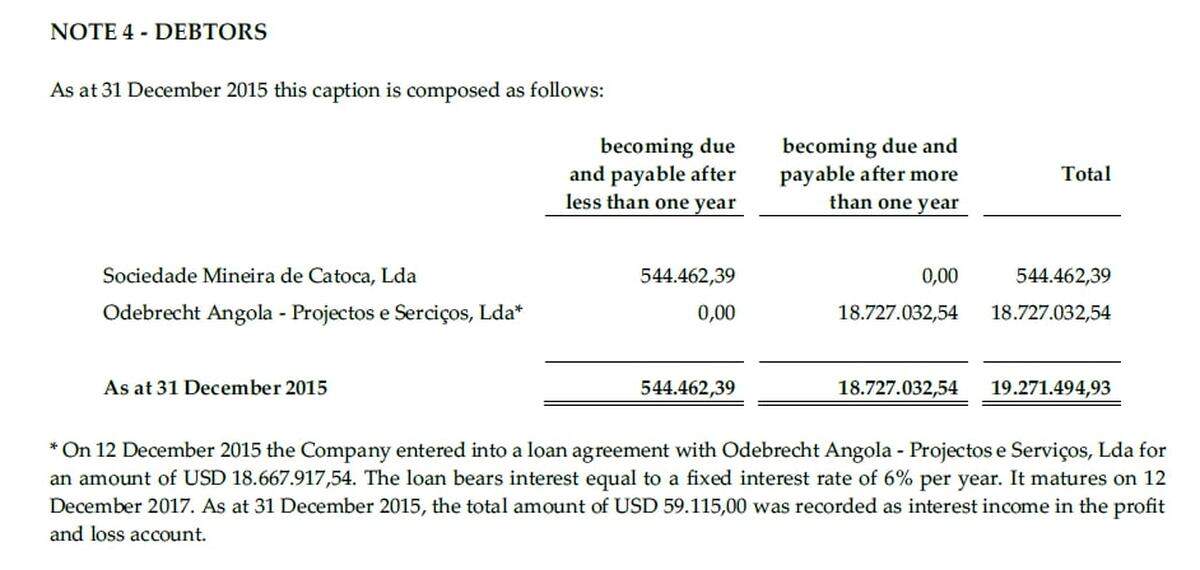
Odebrecht’s Luxembourg companies involved in Africa listed an address in the Talatona section of the Angolan capital of Luanda. That happens to be where Odebrecht won a government contract from President José Eduardo dos Santos to build luxury condos. Dos Santos ruled for 38 years, before falling in 2017. His daughter Isabel gained international notoriety as the wealthiest woman in Africa thanks to an investigation into kleptocracy called Luanda Leaks.
Before its near-death experience, Odebrecht was the largest private-sector employer in Angola. Beyond construction and mining in the oil-rich nation, it has been building a hydroelectric dam and power facility on the Kwanza River.
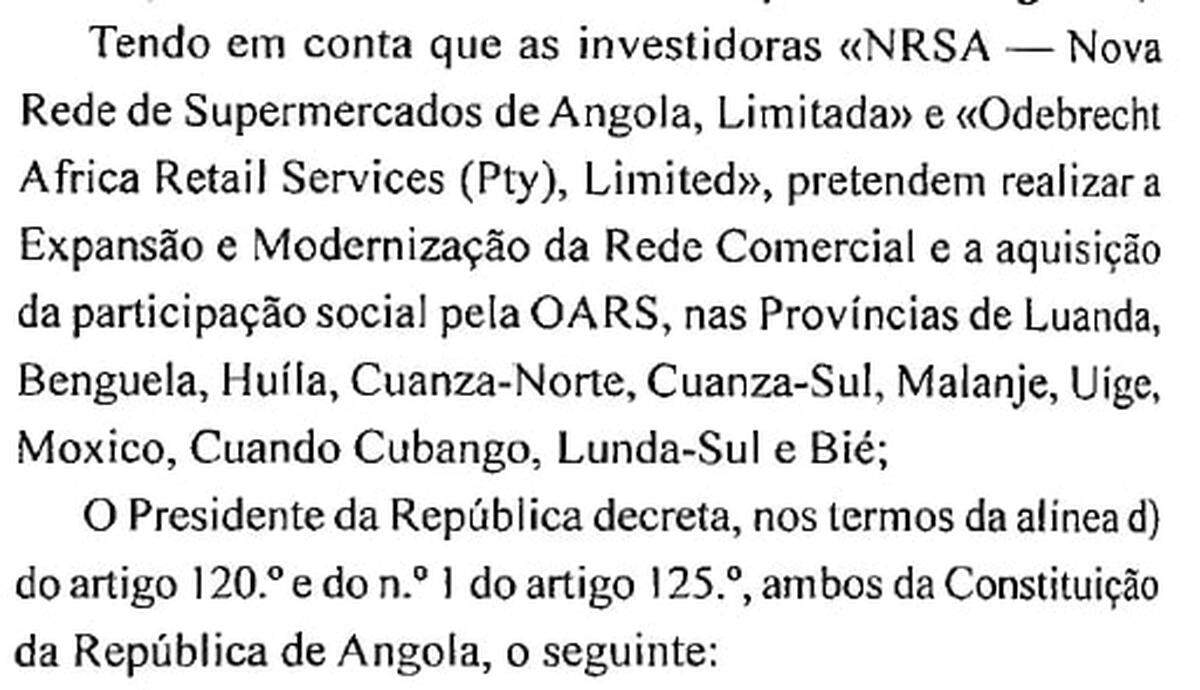
A November 2014 notice in Angola’s federal register featured a presidential decree awarding Odebrecht and a partner a $74 million project to build supermarkets, through a company called Odebrecht Africa Retail Services.
President Dos Santos for decades showed little appetite for fighting corruption, and Odebrecht flourished there for decades, even involved in a diamond mining project with Russia’s state diamond company, Alrosa, and Lev Leviev, the Russian-Israeli billionaire charged with international diamond smuggling in 2018.
How dots connect
A prior global reporting partnership, led by the International Consortium of International Journalists, teased at what Odebrecht might have been up to in Angola.
In a project called The Bribery Division, reporters deciphered logs from a parallel accounting system used by Odebrecht’s special division devoted to paying for bribes, and documented how Miami played an important role.
The logs showed movement of funds between shell companies, using code names for the executives in charge of accounting for the bribes and other irregular, off-balance sheet payments. They show folders belonging to Tushio, a code name for one of the division leaders, Luiz Soares, and transfers to Angola referencing contracts, operations and annual payments. Soares operated out of Miami for a time.
Some of the logs list OEC, which appears to be Odebrecht Engenharia e Construção in Brazil, a construction division that, on paper, became part of Odebrecht Services Sarl in Luxembourg in October 2016.
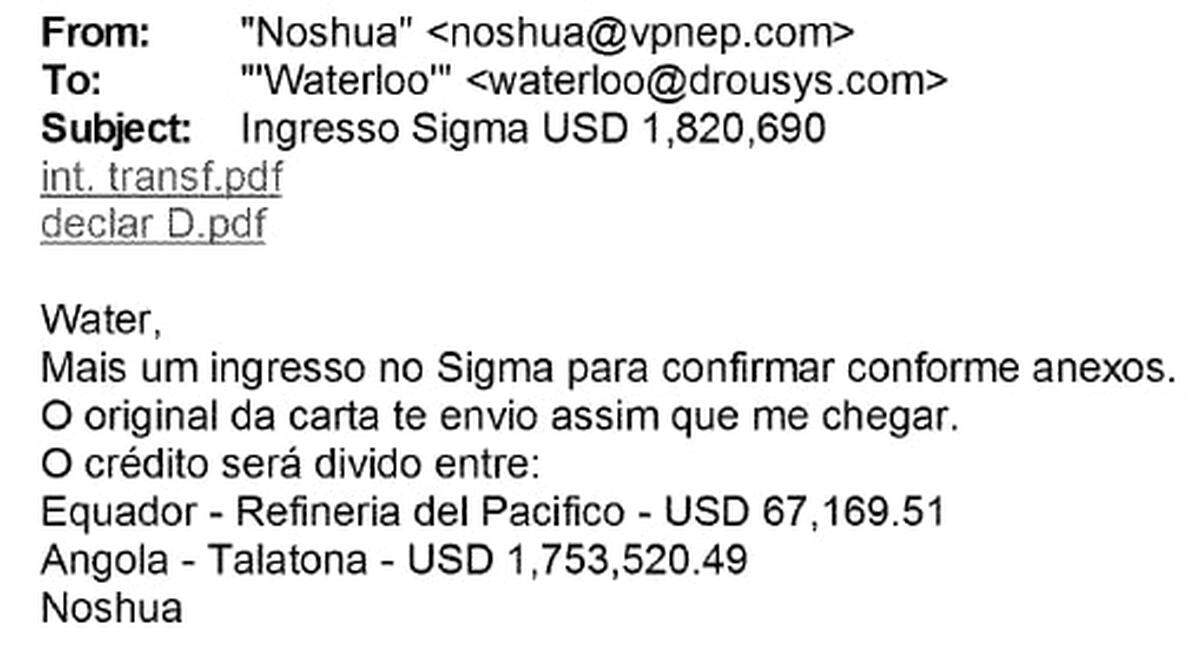
An email in the leak of Odebrecht bribery-division documents also showed two executives communicating under their code names Noshua and Waterloo, arranging the transfer of money to Ecuador and Angola through a shell company called Sigma. It directs a deposit of more than $1.7 million to Angola and notes without explanation Luanda’s Talatona section. (Noshua was never identified, though Waterloo was one of the division leaders, Fernando Migliaccio, who also transferred to Miami.)
The bribery division made payments through Panama, Switzerland and the Antigua branch of Austria’s Meinl Bank. Odebrecht took a majority stake in the Caribbean branch bank in 2010.
Africa to the Andes
In April 2019, about two months before publication of the Bribery Division stories, former Peruvian President Alan García committed suicide as police came to arrest him in connection with what then was alleged Odebrecht bribery.
Peru figured in Odebrecht’s Luxembourg enterprises, too. The corporate registry shows an original firm called Odebrecht Energy Luxembourg Sarl, registered in 2013. It became Odebrecht Latin Investments Sarl in 2014, and an end-of-year report in 2015 describes it as a company for holding investments in Peru and other Latin countries.
On the original registration document is an administrator named Antonio Marco Campos Rabello. He headed the similarly named Odebrecht Energia in Brazil, and appears in a court document and deposition given by then-Odebrecht CEO Marcelo Odebrecht.
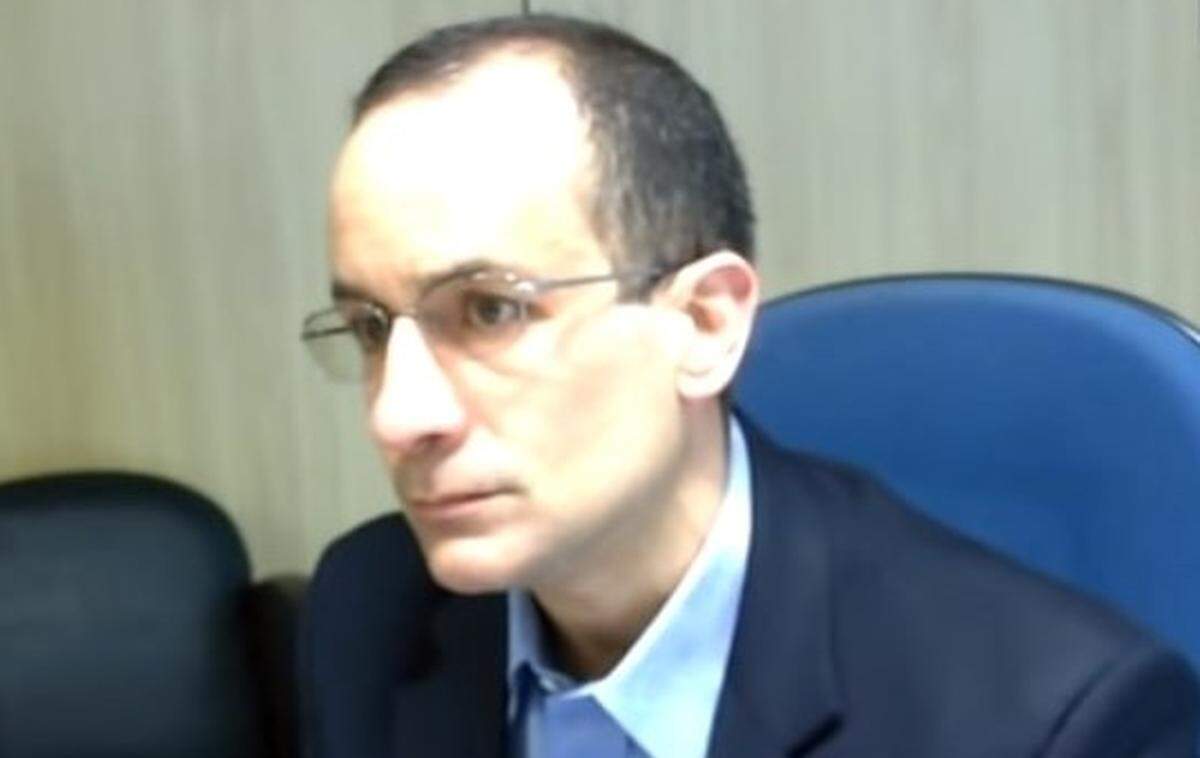
Campos was on an email with division chiefs as they appear to be given talking points from the CEO to ensure they all give the same response to what at the time was a widening scandal.
There is no sign that Campos has faced criminal charges. Also on that email list was Luiz Antonio Mameri, who was later identified as one of the unnamed Odebrecht employees involved in Peruvian bribery and cited in the DOJ indictment.
Mameri was in charge of Latin America and Angola operations and would have been involved in the operations of companies that, on paper, moved to Luxembourg. He was also involved in Odebrecht’s efforts to build a container terminal in the Cuban port city of Mariel.
The 2015 annual report in Luxembourg also identified an entity, Odebrecht Energia del Peru S.A. — one that also appears in Luxembourg’s registry — as being involved with a hydroelectric plant in Peru’s Amazonian region. It also detailed investments in other projects in the Andean nation, where four presidents were alleged to have received bribes from Odebrecht.
In fact, Mameri appeared in emails from 2011 made public in 2018 during Peruvian prosecutions that showed Odebrecht’s country manager in Peru asking for and receiving from Mameri money for the presidential campaign of Keiko Fujimori, the daughter of Peru’s former president Alberto Fujimori.
A report in November 2018 by a German non-governmental organization tracked the evolution of Odebrecht’s Panama-based shell companies to their becoming Luxembourg holding entities under the Latinvest name over a period of 2011 to 2017. In some cases the European company wiring money for Odebrecht projects in Colombia and Peru changed names four times in a year.
“The change of names, ownership and addresses seems to make it hard to trace the money flows and their purpose,” the German report said, adding that “the financial route via Panama and Luxembourg provides an indication that at least tax avoidance may have been involved” along with legitimate use of tax treaties.
Luxembourg to Central America
Even tiny Guatemala, one of the poorest nations in the hemisphere, was on Odebrecht’s to-do list.
Investigations in Guatemala found that Odebrecht provided nearly $40 million in bribes and overpayments, through a government minister to win a highway construction contract, and in donations to presidential campaigns.
An email obtained by Brazilian prosecutors, sent in 2008 by Marcelo Odebrecht, advised board members to lean on then-Brazilian President Luiz Inácio Lula da Silva to speak supportively of Odebrecht when meeting with the Guatemalan president-elect. The company, he noted cryptically, had made illicit campaign contributions.
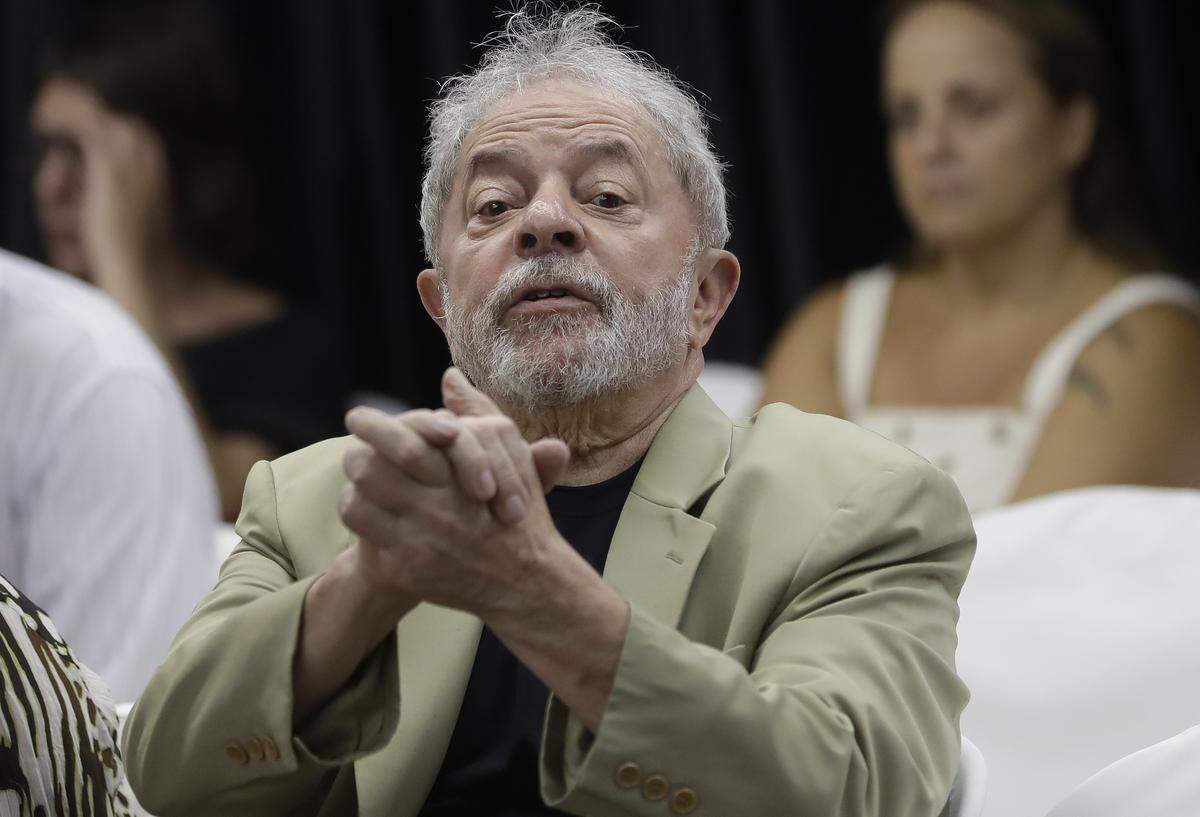
It showed, said prosecutors, how the engineering giant relied on graft in both countries to achieve its aims.
And testimony in late 2017 confirming this illicit activity in Guatemala came by way of an insider witness from Odebrecht who accepted a plea deal back in Brazil. He was an executive in the contracts area, Marcos da Cerqueira Lima Machado.
Coincidentally, he’s also listed on that Luxembourg company with Africa ties, OPI S.A. It’s a small world, after all.
Antonio Baquero and Nathan Jaccard of the Organized Crime and Corruption Reporting Project contributed. The story also used data maintained by the International Consortium of Investigative Journalists.
This story was originally published March 1, 2021 at 9:52 AM.