
For the most part, Puerto Ricans didn’t politicize the COVID vaccine. Here’s the result
Living between Puerto Rico and Hawaii, Camille Ortiz Hernández, 51, noticed how differently both places perceived COVID-19 vaccines.
In Hawaii, there was a clear political divide between those who were getting the vaccine and those who weren’t. But in the Puerto Rican town of Moca, Ortiz Hernández saw less division and more interest in the vaccine.
“I perceived how the political ideology of each one [in Hawaii] determined his or her viewpoint about the vaccine, the pandemic, the social distancing,” the legal clerk said.
Ortiz Hernández was vaccinated in Puerto Rico after returning from the states in March.
Although there were and are Puerto Ricans hesitant to be vaccinated, the unincorporated territory has been relatively successful in fighting COVID-19. The streets are filled with people wearing masks. There has been considerably less fire and fury than on the mainland.
“A lot of people were surprised by Puerto Rico’s numbers,” said Iris Cardona, who headed up the vaccination program for Puerto Rico’s Department of Health.
It’s not as if there aren’t protests against vaccines in Puerto Rico. There are, including one a little over two weeks ago, spurred by a vaccine mandate for all students 12 and older as they came back to school after summer break. It drew about 100 to the capital city of San Juan.
Puerto Rican leaders have seemingly had a freer hand to impose restrictions that would stir fierce controversy on the mainland. In August, Gov. Pedro Pierluisi Urrutia mandated that certain businesses, including restaurants, nail salons, barbershops, casinos and gyms, require all employees to show proof of vaccination. Workers claiming religious or medical exemptions had to show weekly evidence of a negative test. The businesses were required to ask their customers to show proof of vaccination or reduce capacity by 50%.
Employees of the executive and the judicial branches were required to get vaccinated.
In Florida, the Department of Health just announced $5,000 financial penalties for any business that seeks to deny service to unvaccinated customers.
The mandates have been a bridge too far for some in Puerto Rico, with a conservative political party called Proyecto Dignidad labeling them unconstitutional as well as a form of intimidation and coercion.
As to why Puerto Rico has been generally less contentious, some see its political DNA as a prime factor.
The archipelago — consisting of 143 islands, cays, islets and atolls, though just three are inhabited — is not divided between Republicans and Democrats as in the mainland, with party affiliation serving as one predictor of whether someone is likely to get vaccinated. Even though Donald Trump was president when vaccines were developed and approved for use and was credited with initiating Operation Warp Speed, states that supported Trump’s reelection have mostly had lower vaccination rates. (Florida is an exception, with a higher CDC vaccine rate than several states that voted blue.)
Residents of Puerto Rico do not vote in presidential elections and thus are less fixated on Trump, pro or con, political observers noted. What’s more, conservative broadcasting, often a platform for vaccine skepticism on the mainland, is less of a force in Puerto Rico, although, according to Carlos García Arce, professor of audio visual journalism at the University of Puerto Rico, social media fills that gap somewhat. Puerto Rican party platforms tend to be more focused on the territory’s political status, not on red/blue tribal divides.
Death and infection rates
State-vs.-state (or territory) comparisons can be misleading because different jurisdictions use varying standards for counting infections and deaths. For instance, in areas favored by tourists, vaccine doses dispensed to visitors can skew percentages. Some jurisdictions count suspected COVID cases while others don’t.
But numbers maintained by the Centers for Disease Control and Prevention suggest Puerto Rico has effectively distributed the vaccine. According to the CDC, for every 100,000 people in Puerto Rico, the number who had tested positive was 5,372 and the death rate was 90 per 100,000 as of Sept. 2. The segment of the population deemed fully vaccinated stood at 63.4%.
In Florida, the CDC numbers were 15,324 COVID cases per 100,000 population, 213 deaths per 100,000 and 53.4% fully vaccinated.
Nationwide, according to the CDC, here have been 11,894 cases per 100,000 population, 193 deaths per 100,000 and 52.7% fully vaccinated.
David Capó Ramos, former senior epidemiologist at Puerto Rico’s Health Department Epidemiology and Investigation Office, is among those who see a connection between states’ political orientation and the ability to convince residents to get vaccinated.
He says the dynamic in Puerto Rico is different.
“Not everybody [in Puerto Rico] is aware of political issues between Republicans and Democrats in the continental United States,” Capó Ramos said. He added, however, “the people that still have not got their vaccines are possibly more difficult to convince because they are more aware of the concerns discussed in [the 50 states’] conservative media.”
The United States current stark political divide is not relatable to those shaped by Puerto Rico’s unique social, historical and cultural context because those politics embrace a view of the United States they haven’t lived or know, said Jorge Schmidt Nieto, professor of political science at the University of Puerto Rico.
Liliana Cotto Morales, the author of multiple books and academic articles about Puerto Rico, said that the cultural and social differences between Puerto Rico and the mainland have grown more acute in recent years, particularly in light of how some Puerto Ricans felt insulted after enduring the devastation of Hurricane María.
While Puerto Rico was still recovering, President Trump famously criticized the territory as “one of the most corrupt places on earth” and — according to Miles Taylor, ex-chief of staff for homeland security — mused about selling it or trading it for Greenland. (Trump called that fake news.)
For Cotto Morales, the higher vaccination rate is a reflection of Puerto Rico’s uniqueness.
“We are different,” Cotto Morales said.
Lilliam Rodríguez Capó, the president and founder of VOCES, a nonprofit that has vaccinated people during the pandemic, said “the government strategy of using civil groups for distributing the vaccines ...was key,” adding: “For those that do not believe in the government or the pharmaceutical industry, an organization like ours is effective.”
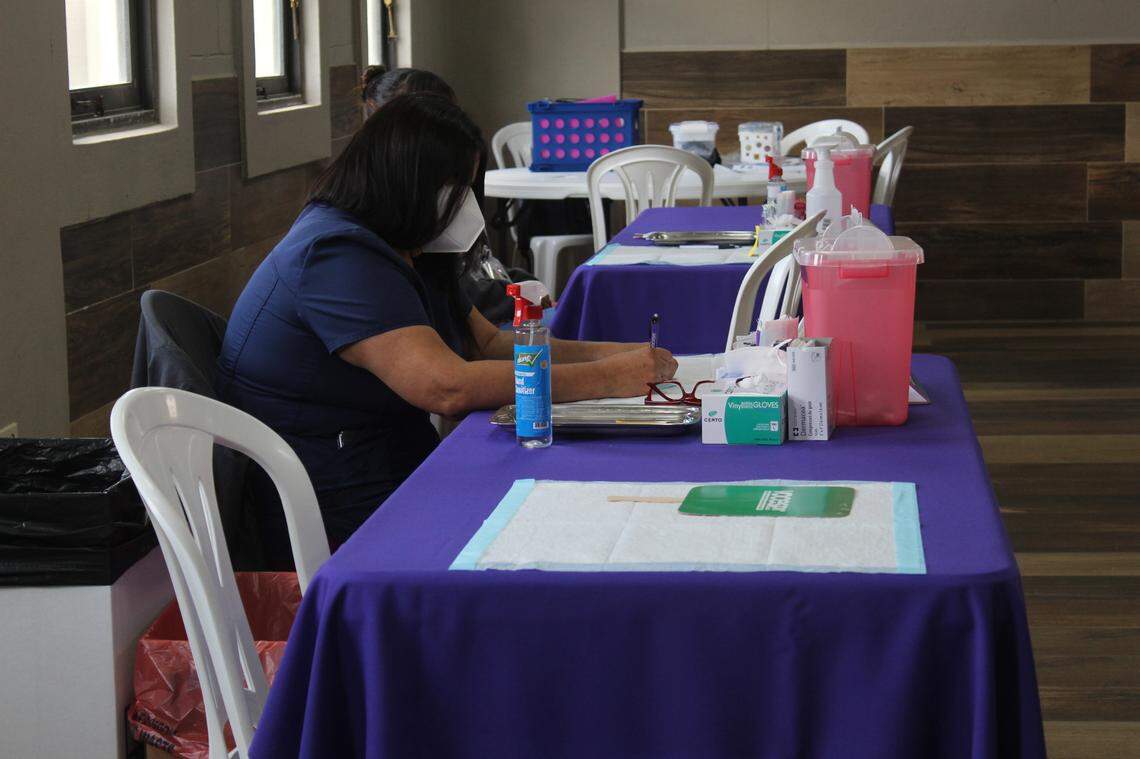
Puerto Rico has more than 600 immunization providers registered in its 78 municipalities. They set up shop in hospitals, medical offices, retail locations, community pharmacies, as well as clinical and treatment centers, said Valerie Acevedo, spokeswoman for Puerto Rico’s Department of Health.
Puerto Rico’s Emergency Management Bureau and the National Guard helped operate drive-thru vaccination events in the first months of the mass vaccination, according to Puerto Rico’s Health Department. But using community leaders to educate communities in Puerto Rico about the virus and the vaccine also helped reduce misinformation, Mónica Feliú Mójer, a science educator, noted.
“In Villalba and Aibonito, among the municipalities with the highest vaccination rates in the [main] island, since early in the vaccination process they worked on the communities organizing census and immunizing in the houses of those without the transportation to get it,” she said.
As part of an educational and health campaign regarding the novel coronavirus, 10 community leaders were trained by Ciencia Puerto Rico, a nonprofit that focuses on scientific issues, to develop a prevention campaign for their communities, said Feliú Mojer, who is also the communications head for the organization.
Scientists, doctors, and experts played an important role in educating during the pandemic, said Daniel Colón Ramos, Yale University professor of cell biology and neuroscience and founder of Ciencia Puerto Rico.
“In Puerto Rico, we have been lucky enough to have prepared health professionals to explain to the people in simple words how the vaccine works,” Colón Ramos noted.
Over TV and radio, health experts detailed the distribution and development process of the COVID-19 vaccine, he said. In order to clarify or refute inaccurate information, they were active on Twitter and Facebook, among other platforms.
Fear and mistrust
And yet, 37% of Puerto Ricans have not been vaccinated, according to CDC data. Mirelsa Modestti González, a clinical psychologist, believes fear and mistrust are to blame.
“In Puerto Rico, it is easier to share information sent by the cousin of your co-worker than objective, fact-checked, and verified scientific information,” Modestti González said.
In addition, conspiracy theories relayed by people who don’t understand the information from the Center for Disease Control and Prevention have caused fear among the unvaccinated, the clinical psychologist said, hindering efforts to get to herd immunity.
Modestti González and Jose Rodríguez Gómez, an epidemiologist and professor at Puerto Rico’s Carlos Albizu University, a private institution on the main island, said that that conspiracy theories have hurt efforts to get people vaccinated.
A just-released study found that Puerto Ricans resistant to taking the vaccine tend to be lower-income, between the ages of 30 to 39, with little history of illness.
The study sample consisted of 1,911 individuals, ages 18 to 90. Slightly more than one in three lived in the metropolitan area and 76% were females.
About 7% reported having no intention of getting the vaccine while 11% were unsure — lower numbers than in similar surveys in the 50 states.
Among the those not getting vaccinated, the most common reasons cited were vaccine safety (63.8%), vaccine efficacy (49.4%), novelty of the vaccine (45.5%), rigor of vaccine testing with a (41.6%) and lack of trust in the government (31.4%). (Respondents could cite multiple reasons.)
Gabriel Soto Rivera, 23, said he was the only member of his working-class family to get the COVID-19 vaccine, which was made available between March and May in Camuy, where he’s from.
In his view, social media misinformation is one factor at the root of his relatives’ reluctance.
“I am very concerned that they are not getting vaccinated,” said the aspiring photojournalist.
And so he moved — to Wyoming.
This story was originally published September 3, 2021 at 8:12 AM with the headline "For the most part, Puerto Ricans didn’t politicize the COVID vaccine. Here’s the result."